
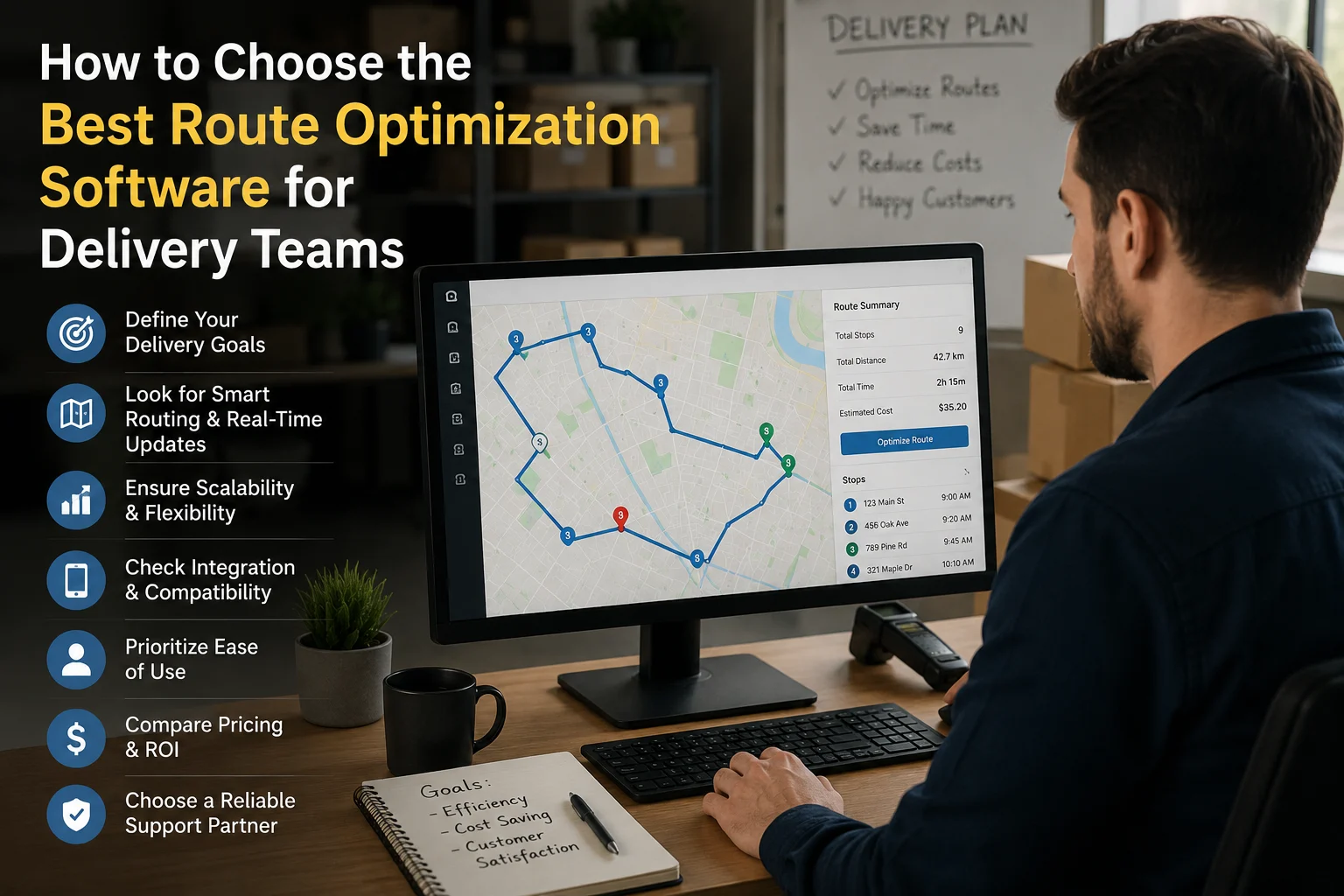

Choosing the right route optimization software is no longer just a technology decision for delivery businesses. It directly affects how efficiently teams plan routes, assign drivers, manage urgent jobs, track deliveries, communicate with customers, and control operational costs.
For courier companies, last-mile delivery operators, e-commerce delivery teams, furniture delivery businesses, 2-man delivery teams, freight operators, and dispatch managers, delivery expectations have changed. Customers want faster delivery windows, clearer ETAs, live tracking, and reliable proof that their order has been delivered. At the same time, delivery businesses need to manage driver availability, fuel usage, delivery density, route capacity, failed deliveries, and same-day delivery pressure.
Manual route planning can work when a business has a small number of jobs. But as order volume increases, manual planning becomes slower, harder to manage, and more prone to mistakes. Dispatchers may spend too much time sequencing stops, drivers may follow inefficient routes, and customers may keep calling for delivery updates.
The best route optimization software should help delivery teams do more than create a route. It should connect route planning with dispatch management, driver tracking, delivery scheduling, proof of delivery, customer notifications, and operational visibility. This is where a delivery management platform such as InstaDispatch becomes valuable for businesses that need control across the full delivery workflow.
What Is Route Optimization Software?
Route optimization software is a system that helps delivery teams plan the most efficient routes based on delivery locations, driver availability, time windows, vehicle capacity, route limits, traffic conditions, and operational priorities.
It helps dispatchers decide the best order of stops, assign jobs to drivers, reduce manual planning, and improve delivery visibility.
There is an important difference between basic route planning and true route optimization:
- Route planning arranges delivery stops into a route.
- Route optimization improves the route based on efficiency, delivery promises, driver workload, route capacity, ETA requirements, and business rules.
For example, a basic route planning tool may help a dispatcher put stops on a map. A more complete delivery route optimization software can help plan multi-stop routes, calculate ETAs, support driver navigation, track progress, and connect the route with proof of delivery and customer updates. InstaDispatch’s route planning page highlights route planning on a map, auto-route optimisation, real-time ETA calculation, route progress tracking, driver app route optimisation, and ePOD collection.
Why Delivery Teams Need Route Optimization Software
Delivery teams need route optimization software because manual planning becomes difficult as delivery volume, customer expectations, and operational complexity increase.
Without proper route planning software, businesses often face problems such as:
Manual planning takes too much dispatcher time. Drivers may follow inefficient routes. Dispatchers may not know where drivers are in real time. Customers may call repeatedly asking for updates. Routes may become overloaded. Same-day deliveries may be difficult to manage. Missed or failed deliveries may increase. Proof of delivery may be inconsistent. Scaling operations may become harder.
These problems are especially common in courier route optimization, last-mile delivery, e-commerce fulfilment, same-day delivery, and multi-drop delivery operations.
A strong route optimization system helps teams plan faster, reduce manual decisions, improve driver productivity, improve delivery visibility, provide better ETAs, manage urgent deliveries, and avoid overloading drivers or routes. It also helps dispatchers stay in control when delivery plans change during the day.
For businesses that depend on fast execution, route optimization should not sit separately from the rest of the operation. It should work with dispatch software, driver tracking software, proof of delivery software, and wider courier management software workflows.
Key Features to Look for in the Best Route Optimization Software
1. Smart Route Planning and Optimization
The first feature to look for is smart route planning and optimization. The software should help create efficient routes automatically instead of forcing dispatchers to manually sequence every stop.
For delivery teams, this matters because route planning affects driver workload, delivery speed, fuel usage, ETA accuracy, and customer satisfaction. A good system should support multi-stop route planning and help reduce unnecessary manual routing decisions.
InstaDispatch supports route planning and optimization by allowing businesses to plan routes on a map and use auto-route optimization for multiple pickups and drop-offs. Its route optimization page also references real-time ETA calculation and route progress tracking, which are important for active delivery operations.
2. Real-Time Driver Tracking
The best route optimization software should include real-time driver tracking. Dispatchers need to know where drivers are, which jobs are in progress, and whether routes are running on schedule.
Live tracking helps operations teams reduce repeated phone calls between dispatchers, drivers, and customers. Instead of asking drivers for location updates manually, teams can monitor route progress and job status inside the system.
InstaDispatch supports live tracking and route progress visibility, helping delivery businesses track activity from pickup to delivery. Its optimisation page specifically mentions tracking route progress in real time to increase transparency and reduce inefficiencies.
3. Dispatch Automation and Job Assignment
Route optimization should connect with dispatch management. It is not enough to create a route if dispatchers still have to manage job assignment manually across spreadsheets, phone calls, and messaging apps.
Good dispatch software should allow teams to assign jobs to available drivers or agents, manage unassigned jobs, and stay in control of urgent same-day deliveries. This is especially important when businesses deal with last-minute bookings, driver availability changes, or urgent delivery requests.
InstaDispatch supports dispatch management workflows by helping delivery businesses assign jobs, manage drivers, and control delivery operations from a central platform.
4. Same-Day Delivery Support
Same-day delivery requires fast decisions. Dispatchers need to see available drivers, active jobs, route progress, new bookings, and urgent delivery requests in one place.
For same-day delivery software, route optimization is important because delivery plans can change during the day. New jobs may come in, drivers may face delays, and customers may expect tight delivery windows.
The right software should support fast planning, live updates, driver availability, and flexible route adjustments. InstaDispatch’s route optimisation page references same-day delivery operations in the context of driver app route optimisation and efficient routing.
5. Route Capacity Planning
Not every route or driver can handle unlimited deliveries. Delivery businesses need route capacity planning so they can define route limits, avoid overloading drivers, and keep delivery promises realistic.
Route capacity planning may include daily job limits, delivery zone limits, vehicle capacity, route workload, driver availability, time windows, or operational rules.
This is especially important for furniture delivery, appliance delivery, 2-man delivery, courier businesses, and scheduled delivery teams where each job may require different handling time, vehicle space, or service requirements.
InstaDispatch supports route capacity planning, helping businesses define delivery limits and avoid overloading routes beyond operational capacity.
6. Driver App Functionality
A route optimization system is only useful if drivers can easily follow the plan. Drivers need a simple mobile app where they can view assigned jobs, delivery instructions, route updates, customer details, status changes, and proof of delivery tasks.
The driver app should work clearly for daily operations. If drivers find the app difficult to use, dispatchers may still receive calls for route details and job updates.
InstaDispatch provides driver app capabilities for Android and iOS. The optimisation page mentions that drivers can select their route in the InstaDispatch Driver App and click through to Google Maps for navigation. It also states that drivers can optimise the route from the app, considering factors such as traffic jams and no-entry zone windows.
7. Proof of Delivery
Proof of delivery is essential for courier companies, last-mile delivery businesses, e-commerce delivery teams, furniture delivery operators, and freight-related delivery workflows.
A strong proof of delivery software feature should support signature capture, image capture, delivery comments, delivery notes, and secure handover confirmation. This helps businesses reduce delivery disputes, confirm completed jobs, and keep accurate delivery records.
InstaDispatch supports electronic proof of delivery, including customer signature and photo capture. Its optimisation page also references secure delivery with OTP and ePOD for delivery confirmation.
8. Customer Communication and ETA Updates
Customers expect visibility. They want to know when the driver is arriving, whether the delivery is on schedule, and how they can track progress.
The best delivery route optimization software should support ETA updates, tracking links, and delivery status notifications. This reduces “Where is my order?” calls and improves the customer experience.
InstaDispatch supports ETA alerts and customer notifications. Its optimisation page states that customer notifications keep clients informed in real time and that the system can send tracking links by SMS or email.
9. Integration with Delivery Management Workflows
Route optimization should not be isolated from the rest of the delivery process. Delivery teams need a system that connects route planning with order management, dispatch, driver tracking, delivery scheduling, proof of delivery, customer communication, reports, and courier management workflows.
If route optimization is disconnected, dispatchers may still need separate tools for assigning drivers, collecting POD, tracking live jobs, and updating customers. This creates more admin work and increases the risk of errors.
A complete delivery management software platform gives teams better control because the delivery journey is managed in one operational workflow.
10. Reporting and Operational Visibility
Delivery managers need visibility into what is happening across routes, drivers, jobs, failed deliveries, delivery times, and operational bottlenecks.
Reporting helps teams understand driver productivity, route performance, delivery issues, and areas where processes can improve. Without reporting, managers may depend on assumptions instead of operational data.
The best route planning software should help managers review delivery performance and make better decisions over time.
How to Compare Route Optimization Software Providers
When comparing route optimization software providers, use a practical checklist rather than looking only at the routing screen.
Ask these questions:
Does the software support your delivery model? Can it handle same-day, scheduled, and multi-stop deliveries? Does it support live driver tracking? Does it include a driver app? Can dispatchers manually adjust routes when needed? Can it manage route capacity? Does it support proof of delivery? Does it scale with your delivery volume? Is it easy for drivers and dispatchers to use? Does it connect with your existing delivery workflows? Does it improve customer visibility with ETAs and tracking updates?
For courier businesses, logistics companies, and last-mile delivery teams, the right choice is usually not the tool with the most features. It is the platform that fits the way your dispatchers, drivers, customers, and operations team actually work.
Common Mistakes to Avoid When Choosing Route Optimization Software
One common mistake is choosing based only on price. A low-cost tool may look attractive, but if it does not support dispatching, driver tracking, POD, route capacity, or customer updates, it may create more manual work later.
Another mistake is choosing a basic mapping tool instead of delivery management software. Mapping tools may help with directions, but delivery businesses usually need route planning, driver assignment, live job tracking, customer communication, POD, and reporting.
Businesses also make mistakes when they ignore driver app usability. If drivers cannot easily use the app, dispatchers may still need to guide them manually.
Other mistakes include overlooking proof of delivery, ignoring same-day delivery workflows, not checking route capacity limits, ignoring customer ETA features, and choosing a system that cannot scale with business growth.
Route Optimization Software vs Delivery Management Software
Standalone route optimization software helps businesses plan routes. But delivery teams often need more than route planning.
A complete delivery management software platform can combine route optimization, dispatch management, driver tracking, delivery scheduling, proof of delivery, customer notifications, reporting, and courier management workflows.
This matters because delivery operations are connected. A route affects the driver. The driver affects the ETA. The ETA affects the customer. The completed delivery needs POD. The dispatcher needs visibility throughout the process.
InstaDispatch is positioned as more than just route optimization software. It supports route planning, dispatching, live tracking, driver apps, proof of delivery, route capacity planning, and courier management workflows. For delivery businesses that want operational control from booking to delivery completion, this broader platform approach is more useful than using separate tools for every step.
Why InstaDispatch Is a Strong Choice for Delivery Teams
InstaDispatch is a strong choice for courier companies, last-mile delivery teams, same-day delivery businesses, e-commerce delivery operations, and businesses that need better control over dispatch, routes, drivers, and proof of delivery.
It helps delivery businesses plan efficient routes, track drivers in real time, assign jobs to drivers or agents, manage delivery progress, and collect proof of delivery. It also supports route capacity planning, which helps businesses avoid overloading routes beyond operational limits.
For drivers, InstaDispatch provides Android and iOS driver app support, helping them manage assigned jobs, route updates, delivery tasks, and POD requirements. For dispatchers, it provides visibility into active delivery work, helping reduce constant manual coordination.
InstaDispatch’s route optimisation page also highlights route planning on a map, ETA calculation, ETA alerts, real-time route progress tracking, driver navigation, driver-side route optimisation, OTP-based secure delivery, and electronic proof of delivery.
This makes InstaDispatch suitable for businesses that need route optimization connected with wider courier management software and last-mile delivery software workflows.
Final Checklist: What the Best Route Optimization Software Should Include
The best route optimization software for delivery teams should include:
- Route optimization
- Route planning
- Live driver tracking
- Dispatch management
- Driver app
- Proof of delivery
- Route capacity planning
- Customer ETA updates
- Same-day delivery support
- Reporting and analytics
- Easy scalability
- Integration with wider delivery workflows
If a provider cannot support these core areas, it may not be enough for growing delivery operations.
Conclusion
The best route optimization software should do more than create routes. It should help delivery teams manage dispatch, drivers, route capacity, live tracking, proof of delivery, customer updates, and overall delivery performance.
For courier companies, last-mile delivery teams, same-day delivery operators, e-commerce delivery teams, and logistics businesses, route optimization works best when it is connected to the full delivery workflow.
Looking for route optimization software that supports dispatch, live tracking, driver apps, proof of delivery, and route capacity planning? Explore InstaDispatch to see how your delivery team can plan smarter routes and manage deliveries more efficiently.
