
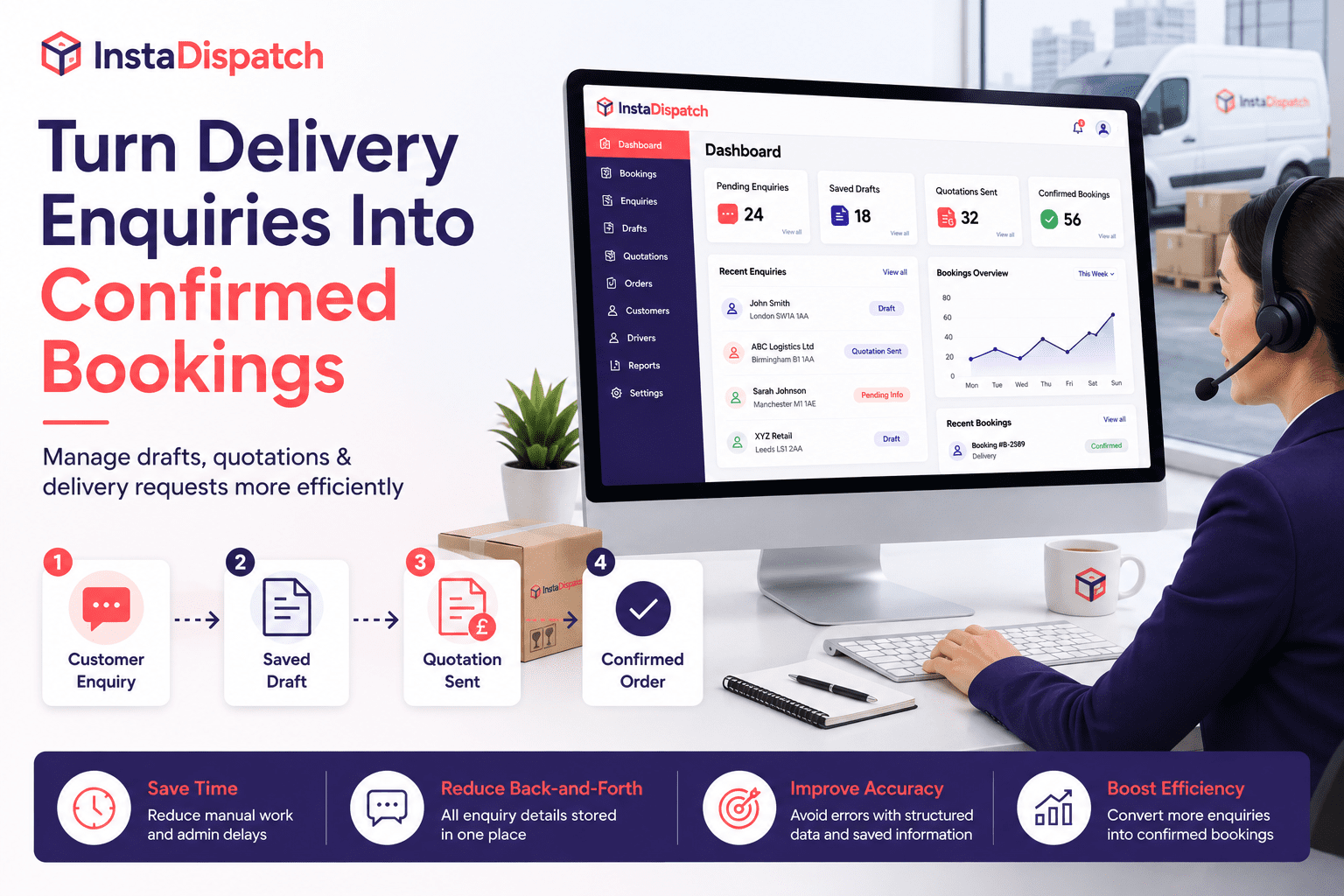

For courier and delivery businesses, the booking process is not always as simple as receiving a request and creating an order immediately.
In real operations, customers often provide information in stages. They may know the pickup and delivery addresses but not the final parcel size. They may ask for a delivery price before confirming. They may need approval from a manager before going ahead. Sometimes, they call back later with missing details. Other times, they ask for a quote but do not confirm on the same day.
When a delivery business does not have a clear way to manage these unfinished or price-led requests, the booking process can become messy. Details can get lost, customers may have to repeat themselves, and teams may spend unnecessary time recreating the same booking again.
This is where features inside a modern courier management software platform from InstaDispatch can make a real difference.
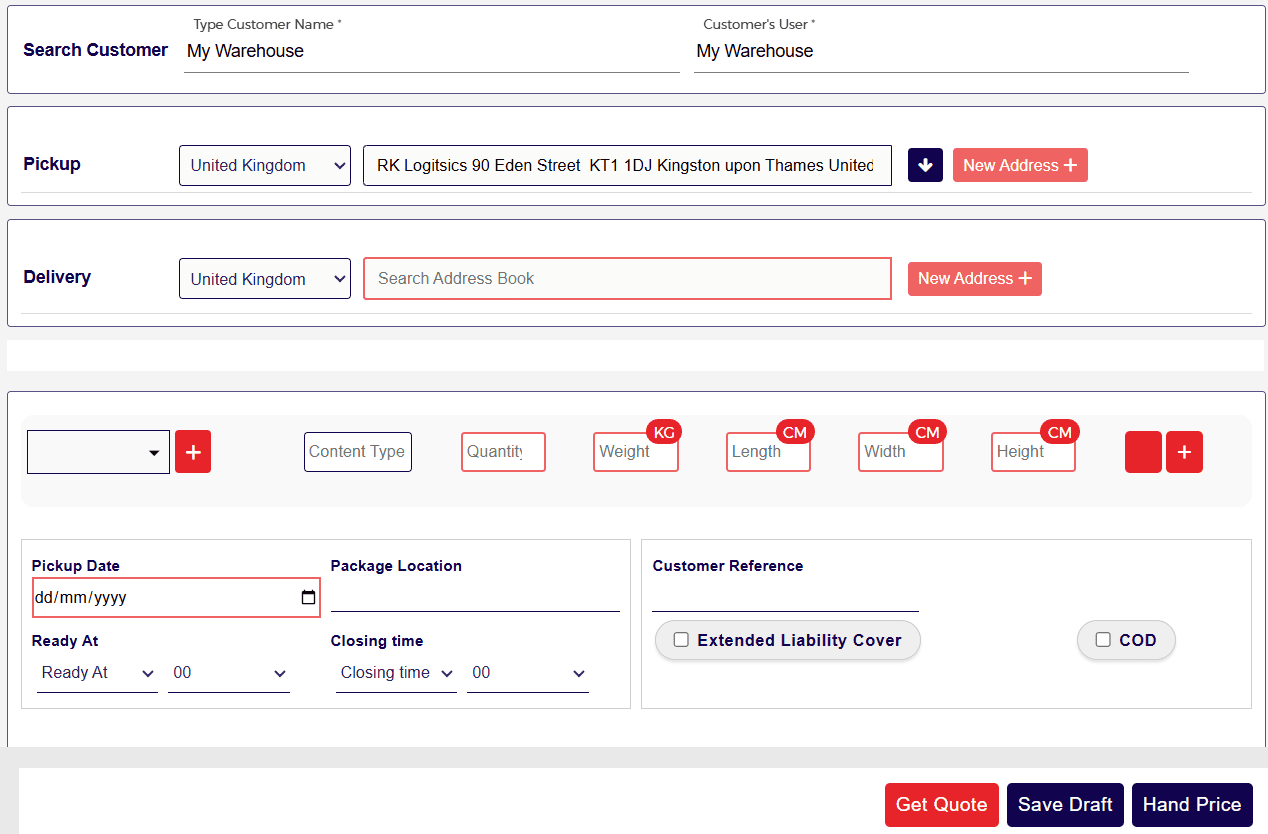
A draft helps a delivery business save shipment details before the booking is fully ready. A quote helps save both shipment details and pricing information when the customer wants a cost before confirming. In InstaDispatch, this distinction is clear: a draft saves shipment details only, while a quotation saves both shipment details and pricing information.
Together, these features help delivery businesses simplify the journey from customer enquiry to confirmed order.
1. Problem: Incomplete Booking Details Get Lost
One of the most common issues in courier operations is incomplete booking information.
A customer may contact the business with only part of the shipment details. They may provide the pickup and delivery address but say they will confirm the parcel weight later. Another customer may know the destination but not the collection date. A business customer may need to check the number of boxes before finalising the booking.
Without a draft feature, this information may be stored outside the main booking process. It could sit in an email, a spreadsheet, a WhatsApp message, a notebook, or someone’s memory.
That creates risk.
If the team gets busy, the enquiry may be forgotten. If another staff member handles the customer later, they may not know what was already discussed. If the information is copied manually later, errors can happen.
Solution
A draft feature in InstaDispatch gives the team a proper place to save the available shipment details before the order is complete.
The booking does not need to be forced into the live order workflow. The team can keep the details stored and return to them when the missing information is ready.
This makes the booking process easier for the customer because they are not pressured to provide everything at once. It also makes the process easier for the team because incomplete bookings are no longer scattered across different places.
2. Problem: Customers Have to Repeat the Same Information
Customers do not want to explain the same delivery request multiple times.
But this often happens when booking details are not saved properly.
A customer may call in the morning and provide the collection address, delivery address, parcel size, and delivery instructions. Later, they call back to confirm the booking, but another team member answers. If the first enquiry was not saved clearly, the customer may be asked to repeat everything.
This creates a poor experience.
It makes the business look disorganised and slows down the booking process. For regular business customers, this can be especially frustrating because they expect the courier company to keep track of their requests.
Solution
Features like saved Drafts and quotes help teams continue from the saved information instead of starting again.
If the customer gave shipment details earlier, those details can be saved as a draft. If the customer received a price, the shipment and pricing information can be saved as a quote.
When the customer returns, the team can pick up from the previous conversation. This reduces repeated questions and makes the customer experience smoother.
The customer feels that the business remembers their request. The team saves time. The booking moves forward faster.
3. Problem: Teams Re-Enter the Same Details Multiple Times
Manual re-entry is one of the biggest hidden problems in delivery operations.
A team member may first write down the customer’s delivery request. Then they may enter the same details into a quote. Later, when the customer approves, they may enter the same details again to create the final order.
This repeated work wastes time.
It also increases the risk of mistakes. Every time an address, postcode, parcel weight, contact number, or instruction is retyped, there is a chance something will be entered incorrectly.
Solution
Features like Drafts and quotations reduce the need to recreate the same booking from scratch.
A draft allows the team to save shipment details when the booking is still incomplete. A quotation allows the team to save the shipment details along with pricing information when the customer needs a price first.
This means the business can capture the information once and continue from it later.
For busy courier teams, this can make daily operations much easier. Less retyping means fewer admin delays, fewer avoidable errors, and a cleaner booking process.
4. Problem: Quotes Become Disconnected from Shipment Details
Many courier and delivery businesses provide prices before customers confirm bookings.
But if the quoted price is not stored with the shipment details, confusion can happen later.
A customer may call back and say, “You quoted me this price.” The team may then need to search through emails, messages, or notes to understand what the quote was based on. Was it for one parcel or three? Was it for same-day delivery or next-day delivery? Was the delivery distance the same? Were the pickup and delivery details final?
If the quote and shipment details are disconnected, the team may struggle to confirm the booking accurately.
Solution
Quotation keeps the price connected to the shipment information.
This is useful because the team can see what was quoted and what delivery details were used. It helps reduce pricing confusion and makes it easier to continue the booking when the customer approves.
For customers, this creates a more professional experience. They can request a price, review it, and come back later without the business losing context.
For the delivery business, it creates a clearer record of quoted work.
5. Problem: Unconfirmed Jobs Are Created as Live Orders Too Early
Another common issue is creating orders before the customer has fully confirmed.
This usually happens when teams do not have a proper place to hold pending bookings. To avoid losing the request, staff may create a live order even though the customer has not approved the price or confirmed the final details.
This can create operational confusion.
Dispatchers may think the job is confirmed. Drivers may be planned too soon. Customer service teams may send updates for a booking that is not yet approved. Operations may treat potential work as actual work.
Solution
Features like saved Drafts and quotes create a useful middle stage between enquiry and confirmed order.
A draft can hold shipment details while the team waits for missing information. A quote can hold shipment and pricing details while the customer reviews the price.
This helps keep pending work separate from confirmed work.
For delivery businesses, this is important because confirmed orders often trigger operational actions such as dispatch planning, driver allocation, customer communication, route planning, and invoicing preparation.
For delivery businesses using delivery dispatch software, this is important because confirmed orders often trigger operational actions such as dispatch planning, driver allocation, customer communication, route planning, and invoicing preparation.
By using drafts and quotes, teams can avoid moving too early and keep the live delivery workflow cleaner.
6. Problem: Pending Enquiries Become Hard to Track
Delivery businesses often handle many enquiries at the same time.
Some customers are waiting for a quote. Some have received a price but have not approved it. Some have provided partial booking details. Some may be ready to confirm but need a follow-up.
Without a clear system, these enquiries can become difficult to track.
The team may not know which opportunities are still open, which customers need a call back, or which quotes are waiting for approval. This can lead to missed follow-ups and lost potential bookings.
Solution
Features like saved Drafts and quotes help create visibility over pending booking activity.
Instead of treating every enquiry as a loose conversation, the business can keep draft bookings and saved quotes organised. This makes it easier for teams to find pending work and continue it when the customer is ready.
In InstaDispatch, saved drafts and quotations can be accessed from the quotations area, where users can open saved drafts or quotations, continue and create the order, delete records, download quotations, and view quotation email templates. The feature detail also mentions filters such as customer, date range, quotation number, load identity, and postcode to help users search saved records.
This gives teams a better way to manage enquiries before they become confirmed orders.
7. Problem: Customer Follow-Ups Are Missed
Follow-up is a major part of delivery booking.
Not every customer confirms immediately. Some need time. Some need approval. Some compare delivery options. Some wait until they have all parcel details.
If a courier company does not have a structured way to manage pending enquiries, follow-ups can be missed.
This can affect customer experience and potential booking conversion. A customer who asked for a quote may never hear back. A customer who said they would confirm later may be forgotten. A draft request may sit in someone’s inbox instead of being followed up properly.
Solution
Features like saved Drafts and quotations make follow-up easier because they keep pending requests visible and organised.
A saved draft can show that the business has shipment details but still needs confirmation or missing information. A saved quotation can show that pricing has been prepared and may be waiting for customer approval.
This gives customer service, sales, and operations teams a clearer view of what needs attention.
The result is a more professional enquiry management process.
8. Problem: Internal Handovers Become Messy
In many courier companies, more than one person may be involved in a booking.
A customer service agent may take the first enquiry. A sales person may prepare the quote. A dispatcher may complete the order later. An operations manager may review special delivery requirements.
If the information is not stored clearly, handovers become difficult.
Team members may need to ask each other for updates, search through messages, or contact the customer again. This slows down the process and increases the chance of mistakes.
Solution
Features like saved Drafts and quotations give teams a shared record of pending booking information.
This makes it easier for one staff member to continue where another left off. The next person can understand what the customer requested, what information is already available, whether a quote has been given, and what still needs to happen before confirmation.
For growing courier and logistics businesses, this is especially useful. As teams become larger, relying on informal communication becomes less reliable.
A structured draft and quotation process helps create consistency across the team.
9. Problem: Pricing Confusion Happens Later
Pricing confusion is common when quotes are not saved properly.
A customer may return after a few hours or days and expect the same price. If the team cannot find the original quote, they may provide a different price or need to calculate it again.
This can create friction.
The customer may feel unsure. The team may spend extra time checking what was agreed. The booking may be delayed.
Solution
A quotation feature helps keep pricing information attached to the delivery request.
This means the business has a clearer record of the price that was saved for the shipment. When the customer comes back, the team can refer to the saved quote instead of relying on memory or scattered communication.
This is particularly useful for business customers who need written pricing before approval.
For courier companies, saved quotes can help create a more reliable and consistent pricing workflow.
10. Problem: The Booking Process Feels Harder Than It Should
A complicated booking process affects both customers and internal teams.
Customers may feel frustrated if they have to repeat details, wait too long for quotes, or deal with unclear next steps. Staff may feel overwhelmed if they have to manage enquiries across emails, spreadsheets, notes, and separate systems.
Over time, this can make the business harder to work with.
Delivery customers usually want a simple process:
They ask for a delivery.
They provide available details.
They receive a price if needed.
They confirm when ready.
The booking is completed without unnecessary back-and-forth.
Drafts and quotes support this type of journey.
They allow the business to meet the customer where they are in the decision process. If the customer is not ready, the request can be saved. If the customer needs a price, a quote can be prepared. If the customer comes back later, the team can continue from the saved information.
This makes the booking process easier, clearer, and more customer-friendly.
Why It Matters for Courier and Delivery Businesses
Delivery businesses win customer trust by making the booking process easy.
Customers do not judge the business only by the delivery itself. They also judge how easy it is to request a price, share details, confirm a booking, and get clear communication from the team.
If the process is full of repeated questions, missing information, and unclear pricing, the customer experience suffers before the delivery even begins.
A more organised booking process helps the business appear more reliable and professional.
It also supports internal efficiency. Teams spend less time searching, retyping, clarifying, and correcting. They can focus more on confirming jobs and managing deliveries.
For courier companies, same-day delivery providers, logistics businesses, and freight operators, this can make daily operations easier to manage.
Conclusion
Turning delivery enquiries into confirmed bookings should not require endless back-and-forth.
Customers should not have to repeat the same details. Teams should not need to recreate the same booking multiple times. Quotes should not get separated from shipment information. Unconfirmed jobs should not enter the live delivery workflow too early.
A smoother process gives delivery businesses a better way to manage the stage between first enquiry and confirmed order.
Saved delivery requests help teams hold shipment details until the booking is ready. Quotations help keep pricing and shipment information together when the customer needs a cost before confirming.
Together, they make the booking process easier for customers and more manageable for courier teams.
For delivery businesses that want fewer repeated questions, fewer manual steps, and better control over pending enquiries, this kind of workflow helps turn customer interest into confirmed bookings without the back-and-forth.
Run dispatch, tracking, proof of delivery and invoicing in one place — see how InstaDispatch fits your delivery operation.
No credit card · Cancel anytime
