
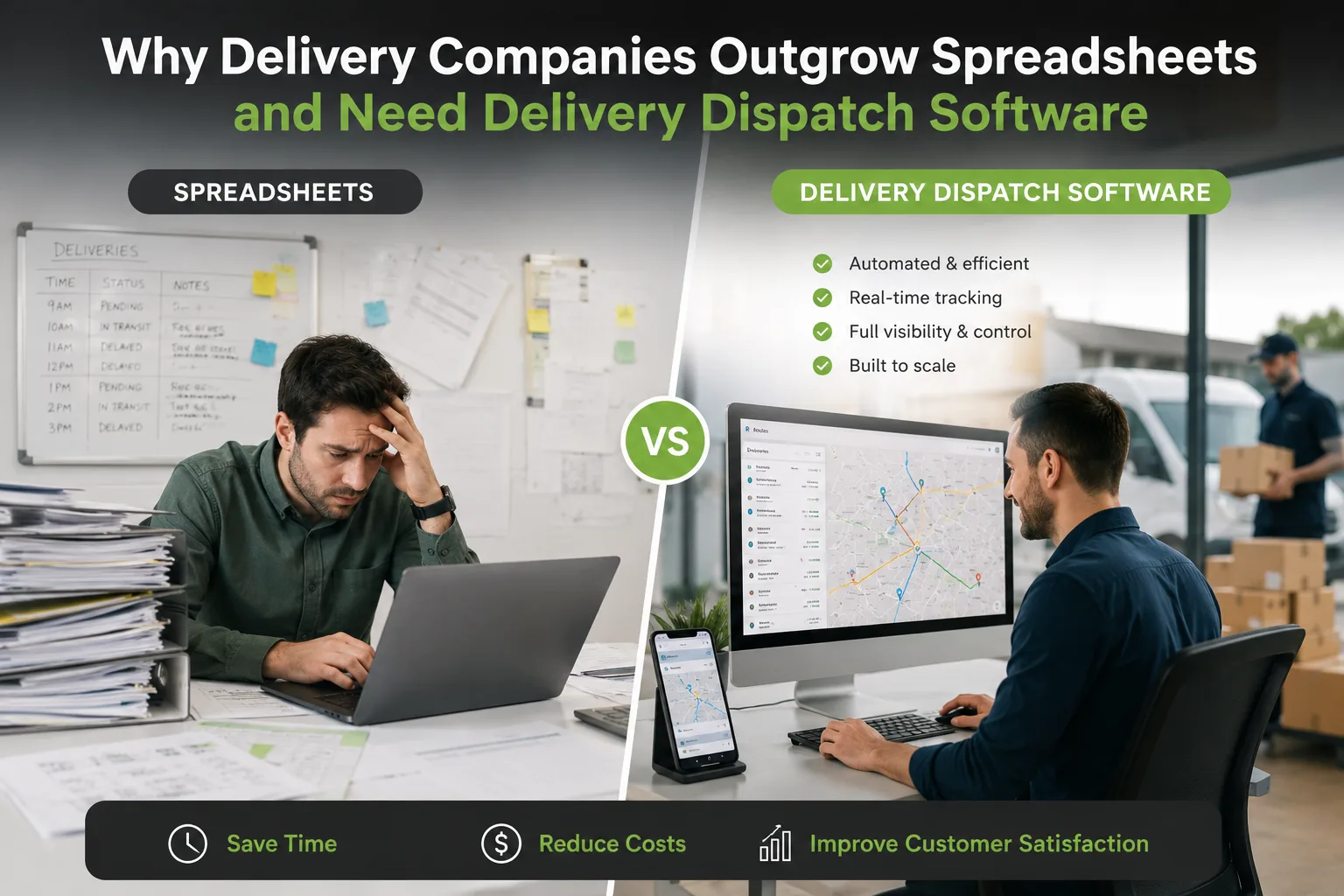

Many delivery companies start with spreadsheets because they are simple, familiar, and low-cost. A dispatcher can list jobs, add customer details, assign a driver, and update delivery status manually. For a small team with a few daily pickups and deliveries, this may be enough.
The problem begins when the operation grows.
More customers means more bookings. More bookings mean more drivers, routes, delivery windows, proof of delivery records, failed delivery attempts, invoices, and customer update requests. At that stage, a spreadsheet is no longer just a planning tool. It becomes the place where everyone is trying to manage a live delivery operation manually.
That is when many courier businesses, same-day delivery companies, freight forwarding teams, logistics operators, and e-commerce delivery teams start looking for delivery dispatch software or online dispatch software.
The goal is not to replace spreadsheets because they are “bad.” The goal is to move live dispatching, driver coordination, delivery tracking, customer notifications, proof of delivery, and invoicing into a system designed for delivery operations.
Why Delivery Companies Use Spreadsheets at First
Spreadsheets are useful in the early stage of a delivery business. They are easy to set up, flexible, and do not require a major process change.
Spreadsheets may work when:
- Delivery volume is low
- Routes are simple
- Only a few drivers are involved
- Customers do not need frequent delivery updates
- Proof of delivery is basic
- Dispatching is handled by one or two people
- Invoices are simple and prepared manually
For example, a local courier business handling a small number of daily jobs may be able to record customer names, pickup addresses, delivery addresses, driver names, and delivery status in one sheet.
At that stage, manual tracking may feel manageable.
But spreadsheets are not built for live delivery operations. They do not automatically update drivers, calculate ETAs, record failed attempts, store proof of delivery in a structured way, or give managers a real-time view of what is happening across the day.
When Spreadsheets Start Slowing Delivery Operations
A delivery company usually outgrows spreadsheets gradually. The warning signs often appear in daily operations before management formally decides to change systems.
Common signs include:
- Dispatchers manually assigning every job
- Drivers relying on phone calls, WhatsApp messages, or emails for job details
- Route plans changing without everyone seeing the latest update
- ETA calculations being manual or inaccurate
- Delivery status not updating in real time
- Failed delivery attempts not being recorded properly
- Proof of delivery stored separately in photos, messages, or folders
- Invoices being prepared manually from incomplete delivery records
- Customers asking for updates because they cannot track shipment progress
- Managers not having one clear view of the day’s operations
These problems do not always happen because the team is disorganised. Often, the team is working hard, but the tools are not built for the complexity of delivery operations.
When dispatchers are switching between spreadsheets, phones, emails, driver messages, invoices, and proof of delivery records, small mistakes become easier to make.
The Hidden Operational Risks of Spreadsheet-Based Dispatching
Spreadsheet-based dispatching creates risks that are not always visible at first.
A duplicate job entry may look like a small admin issue, but it can lead to driver confusion. A missed status update may result in a customer calling the office. A proof of delivery photo stored in the wrong place can delay invoicing or create disputes.
Here are the main risks delivery businesses face when dispatching remains manual.
Duplicate Job Entries
When jobs are entered manually, the same delivery can be added twice. This can lead to confusion over whether a job has been assigned, completed, cancelled, or invoiced.
Missed Pickups or Deliveries
If a dispatcher forgets to update a row, or if the latest version of the spreadsheet is not shared, a pickup or delivery can be missed.
Incorrect Driver Assignment
Manual driver assignment becomes difficult when several drivers are working across different zones, shifts, and delivery windows.
Manual Route Mistakes
Without proper delivery route planning or route optimization software, drivers may receive routes that are inefficient, incomplete, or not updated when changes happen.
Lost Proof of Delivery
Proof of delivery may be stored in driver phones, WhatsApp chats, emails, folders, or separate files. This makes it harder to retrieve delivery confirmation when a customer or billing team needs it.
Delayed Customer Communication
If delivery status is not updated in real time, customers may contact the office for updates. This creates extra pressure on dispatchers and customer service teams.
Inaccurate Delivery History
Manual tracking can make it difficult to understand what happened on a particular job, especially if the delivery involved multiple attempts, route changes, or customer communication.
Slow Billing and Invoicing
Invoices often depend on completed delivery records. If job status, POD, pricing, or customer details are incomplete, invoicing can slow down.
Limited Reporting
Spreadsheets can show data, but they do not always provide operational reporting across jobs, drivers, routes, failed attempts, delivery history, and billing workflows.
No Single Source of Truth
The biggest risk is that no one knows which information is final. The spreadsheet may say one thing, the driver may have another update, and the customer may be waiting for confirmation.
Why Real-Time Visibility Becomes Necessary
As delivery volume grows, delivery companies need to know what is happening now, not what was manually updated earlier.
Operations teams need visibility into:
- Which jobs are booked
- Which jobs are assigned
- Which driver is handling which route
- Which deliveries are completed
- Which attempts failed
- Which customers received updates
- Which proof of delivery records are available
- Which invoices need to be prepared
This is where spreadsheets become limited. They can store information, but they do not manage live delivery workflows in the same way that delivery dispatch software or delivery operations software can.
Real-time visibility helps dispatchers, drivers, managers, and customer service teams work from the same operational view.
What Delivery Dispatch Software Does Differently
Delivery dispatch software is designed to manage the movement of jobs, drivers, routes, delivery updates, proof of delivery, and operational records from one connected system.
Instead of using a spreadsheet as the main control point, delivery companies can manage:
- Booking and job creation
- Driver assignment
- Route planning and route optimization
- ETA calculation
- Pickup and delivery tracking
- Driver mobile app updates
- Electronic proof of delivery
- Failed delivery attempt records
- Customer notifications
- Delivery history
- Reporting
- Invoicing and pricing workflows
- Integrations with e-commerce, accounting, and carrier systems where supported
InstaDispatch is a delivery management software platform for courier, logistics, freight forwarding, same-day delivery, parcel delivery, and e-commerce delivery businesses. Its available pages describe support for booking, dispatching, route planning, live tracking, proof of delivery, invoicing, integrations, customer notifications, and driver app workflows.
Spreadsheets vs Delivery Dispatch Software
| Spreadsheet-based dispatching | Delivery dispatch software |
| Jobs are entered and updated manually | Jobs can be created, assigned, tracked, and managed in one workflow |
| Driver assignment depends on manual updates | Dispatchers can assign drivers through a dispatch management software workflow |
| Route planning is usually manual | Route optimization software can support route planning and ETA workflows |
| Drivers rely on calls, messages, or emails | A delivery driver app can share job details and status updates |
| ETA accuracy depends on manual estimation | Delivery ETA accuracy can be supported through route and tracking workflows |
| Delivery tracking is updated after someone edits the sheet | Delivery tracking software can provide more live operational visibility |
| Failed delivery attempts may be recorded inconsistently | Failed delivery attempts can be captured as part of the delivery record |
| Proof of delivery may be stored separately | Proof of delivery software can help capture and store POD records |
| Customer updates depend on staff communication | Customer delivery notifications can be automated where configured |
| Invoices are prepared manually from delivery data | Delivery invoicing software can support billing and invoice workflows |
| Reporting depends on spreadsheet structure | Delivery operations software can provide clearer operational records |
| Scaling requires more manual coordination | Delivery workflow automation helps reduce manual pressure as volume grows |
Why Growing Delivery Companies Need More Than Manual Tracking
When a delivery business grows, the work does not just increase in volume. It increases in complexity.
There are more drivers to manage, more deliveries to assign, more customer expectations to meet, more route changes to handle, more proof requirements to record, more billing rules to apply, and more operational exceptions to resolve.
At first, many companies try to solve this by adding more people. That can help, but only up to a point.
If the delivery process is still manual, every new person also needs to check spreadsheets, read messages, confirm job details, call drivers, update customers, and search for POD records. The workflow itself remains slow.
Delivery workflow automation does not remove the need for good dispatchers or operations managers. It gives them a better system to work with.
For example, a dispatcher should not have to manually chase every driver for delivery status. A billing team should not have to search different folders to confirm whether a job was completed. A customer service team should not need to ask multiple people before answering a delivery update question.
Also Read: Why Same-Day Courier Teams Struggle With Manual Driver Dispatch
How InstaDispatch Supports Delivery Companies
InstaDispatch can support delivery companies by bringing several delivery workflows into one connected platform.
Based on available InstaDispatch information, the platform supports delivery management, courier management, dispatching, route planning, live tracking, proof of delivery, invoicing, integrations, customer notifications, and driver app workflows.
For delivery teams moving away from spreadsheets, useful InstaDispatch capabilities include:
Delivery and Courier Management
InstaDispatch supports courier and delivery management workflows for businesses handling bookings, dispatch, tracking, POD, invoicing, and integrations, making it useful for teams comparing courier company software.
Same-Day and Last Mile Delivery Operations
For same-day delivery companies and last mile delivery software requirements, InstaDispatch includes operational workflows such as customer portal booking, delivery updates, and customer communication features.
Route Optimization
The InstaDispatch route optimization page describes route planning and ETA support for delivery teams. This is relevant for businesses that want to move from manual delivery route planning to a more structured routing workflow.
Driver Mobile App
The delivery driver app supports drivers with mobile delivery workflows, tracking, updates, and proof of delivery-related activity.
Proof of Delivery
InstaDispatch information refers to POD and signature capture through the mobile app, helping delivery teams keep proof of delivery records connected with the delivery workflow.
Customer Portal and Customer Updates
Customer portal access and customer communication are included in available InstaDispatch feature information. WhatsApp delivery notifications are also listed as an integration option for sending delivery updates, tracking links, PODs, and support messages.
Invoicing Support
InstaDispatch includes invoice management-related workflows, including invoice generation, payment tracking, pricing rules, and financial reports according to its help center information.
Integration Options
Available InstaDispatch data mentions integrations with e-commerce, accounting-related workflows, carriers, and platforms such as DHL, FedEx, eBay, Shopify, QuickBooks, and Linnworks. Integration availability should be checked based on the customer’s required workflow.
Questions Delivery Companies Should Ask Before Replacing Spreadsheets
Before moving from spreadsheets to courier dispatch software or delivery management software, delivery companies should review their daily operations.
Ask these questions:
- Are dispatchers spending too much time updating sheets?
- Are drivers calling or messaging for job details?
- Are customers asking for updates manually?
- Are failed attempts hard to track?
- Is proof of delivery scattered across tools?
- Are invoices delayed because delivery records are incomplete?
- Is route planning still manual?
- Is delivery ETA accuracy difficult to maintain?
- Is the team relying on one person to know what is happening?
- Are managers missing a clear view of booked, assigned, completed, and failed deliveries?
- Are customer delivery notifications handled manually?
- Are delivery records difficult to search later?
If the answer is yes to several of these questions, the business may have outgrown spreadsheet-based dispatching.
Conclusion
Spreadsheets can help delivery companies start. They are simple, flexible, and familiar. But they are not designed for live delivery operations, which is why growing teams often need purpose-built software for delivery workflows.
As delivery volume grows, companies need better visibility, driver coordination, ETA management, proof of delivery, failed attempt records, customer updates, reporting, and invoicing workflows.
That is why many courier companies, same-day delivery businesses, logistics teams, freight forwarding operators, and e-commerce delivery operations eventually move from manual spreadsheets to delivery dispatch software.
If your delivery team has outgrown spreadsheets, InstaDispatch can help you manage dispatching, routes, drivers, tracking, proof of delivery, and delivery workflows in one platform. Book a demo to see whether it fits your delivery operation.
