
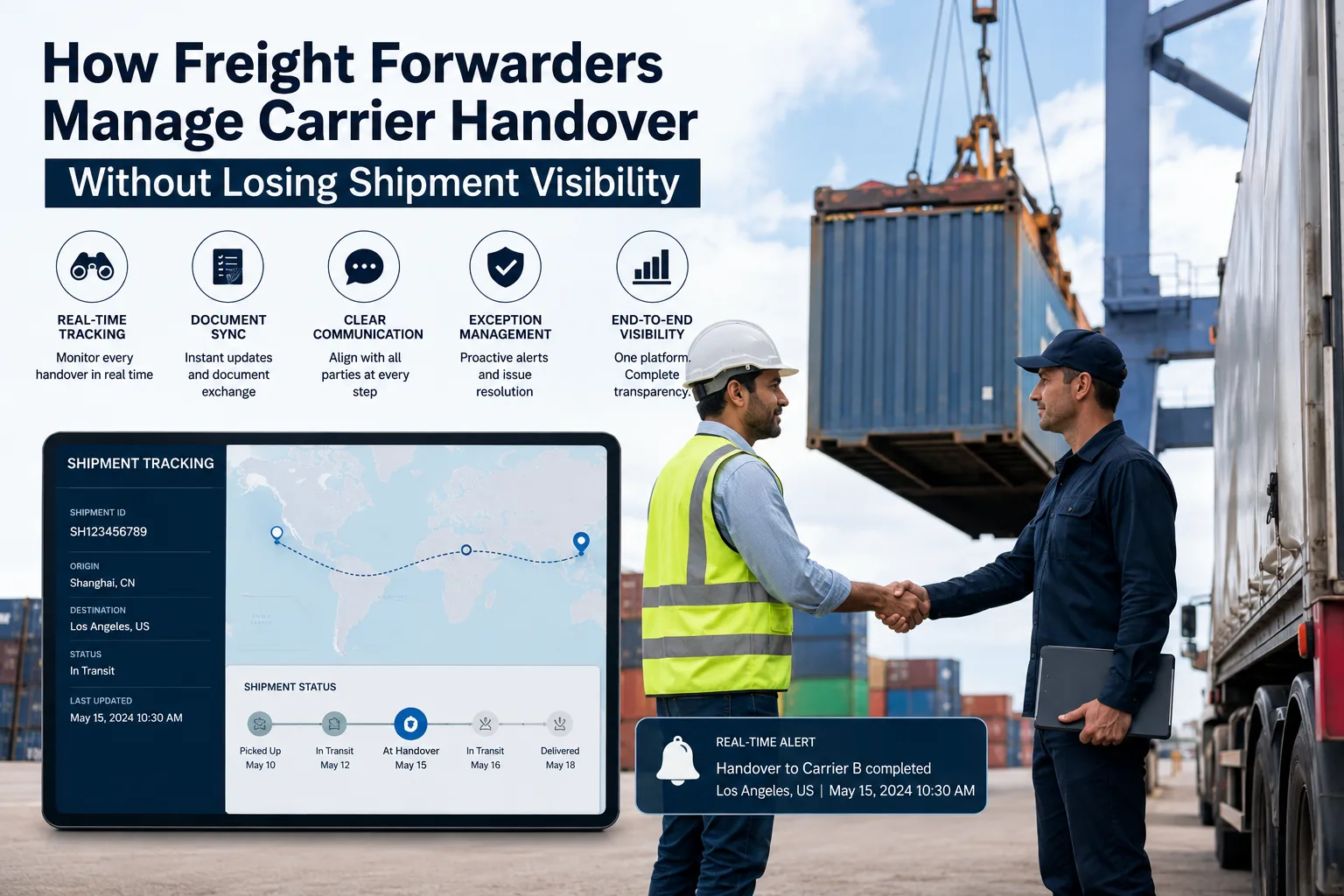

Carrier handover shipment visibility is one of the most important operational challenges in freight forwarding. Even with a well-managed booking, collection, sorting, and dispatch process, visibility can quickly drop when a shipment moves from one carrier, depot, route, hub, or delivery partner to another. This is why many freight forwarders now rely on a structured freight forwarding system to keep shipment tracking, carrier handover records, manifests, and proof of delivery connected in one operational workflow.
This is where many freight forwarders lose control of shipment status updates, proof of delivery, exception reporting, and customer communication. A structured freight forwarding software setup can help connect shipment records, scan events, manifests, and carrier handover checkpoints so visibility does not depend only on manual updates.
For freight forwarders, courier companies, and logistics operators, carrier handover needs to be treated as a controlled operational milestone, not just a physical transfer of parcels or freight.
Quick Answer: How can freight forwarders manage carrier handover without losing shipment visibility?
Freight forwarders can maintain visibility during carrier handover by using accurate shipment data, barcode scanning, digital manifests, clear status milestones, exception reporting, and proof of delivery workflows. Each handover should confirm what was expected, what was physically transferred, who accepted responsibility, and what status customers can see after the shipment moves forward.
What Carrier Handover Means in Freight Forwarding
Carrier handover is the point where responsibility for a shipment moves from one party, route, hub, depot, or delivery partner to another. In freight forwarding, this can happen several times before the shipment reaches the final recipient.
A carrier handover process may happen when:
- A shipment moves from the freight forwarder to a carrier
- A shipment moves from one carrier to another
- Linehaul freight is passed to a local delivery partner
- A depot transfers shipments to final-mile drivers
- Shipments are consolidated, bagged, manifested, or handed over in bulk
- A delivery partner accepts responsibility for a defined route or service area
In simple terms, handover is the moment where operational ownership changes. If that change is not recorded properly, teams may not know who last handled the shipment, where it was scanned, whether it was accepted, or whether the next delivery milestone has started.
For freight forwarders managing multiple routes, carriers, and depots, this creates a visibility risk. One missing scan or inaccurate manifest can make a shipment appear “stuck” even when it is physically moving.
Why Shipment Visibility Is Lost During Carrier Handover
Shipment tracking visibility is often lost because handover sits between two operational environments. The freight forwarder may use one process, the carrier may use another, and the final-mile team may work from a different system or manual list.
Common causes include:
Manual paperwork
Paper manifests, handwritten notes, and printed route sheets may work for small volumes, but they create gaps when shipment volume increases. Paper records are difficult to update in real time and easy to misread, lose, or delay.
Delayed status updates
A shipment may be physically handed over, but the system may not be updated until later. Without consistent shipment tracking updates, the operations team may not know whether the shipment has been received, sorted, handed over, accepted, or moved to final-mile delivery. This delay creates confusion for dispatchers, customers, and customer service teams.
No real-time scan confirmation
Without parcel scanning at key checkpoints, teams have to rely on manual confirmation. This makes it harder to prove whether a shipment was received, sorted, bagged, manifested, handed over, or accepted by the next carrier.
Multiple systems used by different parties
Freight forwarders often work with carriers, subcontractors, depots, and delivery partners that operate differently. If these parties do not share status updates clearly, shipment visibility becomes fragmented.
Poor manifest accuracy
A manifest should show what is expected to move in a handover. If shipments are missing, duplicated, wrongly assigned, or placed under the wrong carrier, the handover becomes difficult to reconcile.
Lack of accountability
When no clear checkpoint shows where responsibility changed, disputes become harder to resolve. Teams may not know whether the shipment was still with the freight forwarder, already with the carrier, or waiting at a depot.
Missing exception updates
Exceptions such as damaged parcels, wrong route allocation, failed scans, or rejected shipments must be recorded immediately. If they are not recorded at handover, they often become customer complaints later.
The Operational Impact of Poor Handover Visibility
Poor freight forwarding visibility creates more than a tracking problem. It affects operations, customer service, billing, and carrier relationships.
More support calls
When customers cannot see shipment status updates, they contact the operations team. Dispatchers then have to manually check with depots, drivers, carriers, or delivery partners.
More manual follow-ups
Operations teams may spend time calling carriers, checking spreadsheets, reviewing emails, or asking drivers for updates. This slows down the team and increases the chance of inconsistent answers. This is where freight management software can help teams check shipment progress, carrier status, exceptions, and delivery history from one place.
Higher risk of lost or delayed shipments
If a shipment is assigned to the wrong route, missed during consolidation, or not accepted by the carrier, it may not move as planned. Without scan checkpoints, the issue may only be discovered after the delivery window has passed.
Failed delivery attempts
If delivery instructions, address details, or customer availability information do not pass through the handover correctly, the final-mile team may attempt delivery without the right information.
Carrier disputes
If a carrier says it never received a shipment and the freight forwarder says it was handed over, both parties need proof. Without scans, manifests, or status history, responsibility becomes difficult to prove.
Billing and surcharge issues
Incorrect shipment counts, service levels, weight details, or carrier assignments can affect billing. Handover visibility helps teams reconcile what was planned, what was handed over, and what was delivered.
Poor customer experience
Customers expect updates even when shipments move through multiple carriers. A lack of visibility makes the business look disorganised, even when the shipment is still moving.
How Freight Forwarders Can Maintain Visibility Before Handover
Visibility does not start at handover. It starts at booking.
Freight forwarders should prepare shipment data properly before the shipment reaches the carrier handover stage.
Capture complete shipment details at booking
Every shipment should have clear booking details, including sender, recipient, destination, service type, parcel count, delivery instructions, collection information, and any special handling notes.
Incomplete booking data creates problems later because every downstream process depends on it.
Use accurate labels or barcode references
Barcode labels help connect the physical shipment to the digital record. If the barcode is missing, damaged, duplicated, or not scannable, the shipment becomes harder to track during sorting, manifesting, and handover.
Group shipments correctly before manifesting
Shipments should be grouped by carrier, route, service type, destination, depot, or delivery partner depending on the operational model. Incorrect grouping increases the risk of wrong carrier allocation.
Validate destination and service instructions
Before handover, teams should confirm that each shipment is assigned to the correct destination, service level, carrier, and route. This is especially important for multi-carrier shipment tracking.
Prepare digital manifests
A digital manifest gives the operations team a structured list of shipments expected in the handover. It helps compare planned shipment movement against actual scan events.
Confirm shipment count before handover
The expected shipment count should match the physical count. Any missing, extra, damaged, or rejected shipment should be recorded before the handover is completed.
Set clear status milestones
Freight forwarders should define operational milestones such as received, sorted, manifested, ready for handover, handed over to carrier, received by delivery partner, out for delivery, and delivered.
How Scanning Improves Carrier Handover Control
Parcel scanning is one of the most practical ways to maintain carrier handover shipment visibility. Every scan creates an operational checkpoint.
Useful scan events include:
- Received at depot
- Sorted
- Bagged or consolidated
- Manifested
- Ready for handover
- Handed over to carrier
- Received by next carrier or delivery partner
- Out for delivery
- Delivered
These scan events help freight forwarders answer important operational questions:
- Was the shipment received?
- Was it sorted correctly?
- Was it included in the correct manifest?
- Was it physically handed over?
- Did the next carrier accept it?
- Is it now moving through final-mile delivery?
- Was proof of delivery captured?
Scanning reduces reliance on memory, paper records, and delayed manual updates. It also gives dispatchers and operations managers a clearer view of shipment movement across hubs, depots, routes, and delivery partners.
When scan data is connected to shipment status updates, customer teams can provide more accurate answers without repeatedly contacting drivers or carriers.
The Role of Manifesting in Carrier Handover
Manifesting is the process of creating a structured shipment list for movement, carrier transfer, route dispatch, or delivery partner handover.
In freight forwarding, manifesting matters because shipments are often moved in groups. A carrier may receive multiple parcels, bags, consignments, or consolidated shipment sets at once.
A good manifest helps with:
Shipment grouping
Shipments can be grouped by carrier, route, destination, service type, depot, or delivery partner. This helps reduce misrouting.
Carrier-level shipment lists
The carrier receives a clear record of what is expected in the handover. This supports accountability and reconciliation.
Service-level separation
Express, same-day, scheduled, economy, and special handling shipments may need different treatment. Manifesting helps separate them correctly.
Handover confirmation
The manifest acts as the expected handover record. Scans and physical counts can then confirm whether the handover is complete.
Exception identification
If a shipment appears on the manifest but is not physically present, the issue can be identified before the carrier leaves.
Reconciliation
Freight forwarders can compare expected shipment counts against actual scanned or accepted shipment counts. This helps identify missing, extra, or incorrectly assigned shipments.
Manifesting is not just an admin task. It is a control point in the logistics handover process.
Managing Exceptions During Handover
Even with strong processes, exceptions happen. The goal is not to eliminate every exception, but to record and communicate them quickly.
Common handover exceptions include:
- Missing parcel
- Damaged parcel
- Wrong route
- Wrong carrier
- Failed scan
- Incorrect address
- Shipment not accepted by carrier
- Mismatch between manifest and physical count
- Shipment held at depot
- Delivery instruction missing
Freight forwarders should have a clear process for each exception.
First, the issue should be recorded against the shipment record. Second, the shipment status should be updated so operations teams know what happened. Third, the correct team, carrier, or customer should be informed where needed. Fourth, the shipment should be reworked, reassigned, held, or escalated depending on the issue.
For example, if a parcel is assigned to the wrong carrier, the system should show that it was not handed over successfully. The team can then reassign it before it creates a delivery failure.
Exception handling is especially important in multi-carrier shipment tracking because one unresolved issue can affect the entire customer experience.
Also Read: Freight Consolidation Software: How Bagging, Manifesting and Carrier Handover Work
Maintaining Customer Visibility After Carrier Handover
Customer visibility should not stop when the freight forwarder hands the shipment to another carrier or delivery partner. Strong shipment tracking helps customers see whether the shipment has been handed over, received by a delivery partner, moved out for delivery, attempted, or delivered.
Customers still expect clear shipment status updates, delivery progress, and proof that the shipment has been delivered. This means the freight forwarder needs a process for customer-facing updates after handover.
Important updates may include:
- Shipment handed over to carrier
- Received by delivery partner
- Out for delivery
- Delivery attempted
- Failed delivery reason
- Delivered
- Proof of delivery available
Customer portals, tracking pages, email updates, SMS updates, or WhatsApp notifications can help reduce “where is my shipment?” enquiries.
The key is consistency. If the internal team can see an update but the customer cannot, support calls may still increase. If the customer receives an update but the operations team cannot verify it, disputes may become harder to manage.
Strong shipment tracking visibility requires both internal and customer-facing clarity.
Why a Freight Forwarding System Helps Maintain Shipment Tracking Visibility
Freight forwarders often manage complex shipment movement across bookings, depots, carriers, routes, drivers, and customers. A freight forwarding system or delivery management system can act as a central control layer for these operations.
For some businesses, this may also be compared with a TMS for Freight Forwarders, but the core need is the same: keeping booking records, carrier handover, shipment tracking, manifests, and proof of delivery connected in one workflow.
A delivery management software for freight forwarders, or freight forwarding software, can help centralise:
- Booking records
- Dispatch visibility
- Carrier and route assignment
- Driver app workflows
- Barcode scanning
- Manifesting
- Shipment status updates
- Customer notifications
- Proof of delivery
- Status history
- Operational reporting
For freight forwarders handling multi-carrier movement, freight operations software helps connect the operational steps that happen before, during, and after carrier handover.
This does not mean every external carrier must use the same system in the same way. But the freight forwarder needs one reliable place to manage its own operational truth.
A central system helps teams understand what was booked, what was scanned, what was manifested, what was handed over, what was delivered, and where exceptions occurred.
Without a single source of truth, teams often depend on emails, spreadsheets, calls, paper manifests, and disconnected updates. That makes it harder to manage high-volume freight forwarding visibility.
Practical Carrier Handover Checklist for Freight Forwarders
Use this checklist before, during, and after handover:
- Are all shipment details complete?
- Are labels or barcodes scannable?
- Is the shipment assigned to the correct carrier?
- Is the shipment assigned to the correct route, depot, or delivery partner?
- Has the manifest been generated?
- Has the shipment count been verified?
- Have missing or damaged items been recorded?
- Has the handover scan been completed?
- Has the receiving carrier or delivery partner confirmed acceptance?
- Are exceptions recorded against the shipment?
- Are customers able to track shipment progress?
- Are delivery attempt updates visible?
- Is proof of delivery captured at delivery?
- Can the team identify who had responsibility at each stage?
- Can operations reconcile expected shipments against actual handover records?
This checklist helps turn handover from a manual transfer into a controlled operational milestone.
How InstaDispatch Supports Freight Forwarding System Workflows
InstaDispatch is a cloud-based delivery management software built for courier, delivery, logistics, and freight forwarding businesses.
For freight forwarding teams, InstaDispatch can work as freight forwarding software to support operational visibility through delivery management workflows such as booking management, dispatching, parcel scanning, tracking updates, route visibility, driver app workflows, customer communication, and proof of delivery.
This can help teams manage shipment movement from booking through dispatch, carrier handover, delivery progress, and final proof of delivery.
Conclusion
Freight forwarders do not lose shipment visibility because carrier handover exists. They lose visibility when the handover is unmanaged, manual, delayed, or disconnected from shipment status updates.
A strong carrier handover process should confirm what was expected, what was physically transferred, who accepted responsibility, what exceptions occurred, and what the customer can see after the shipment moves forward.
By using structured booking data, scannable labels, digital manifests, shipment status updates, exception handling, and proof of delivery, freight forwarders can maintain control across carriers, depots, routes, and delivery partners.
Want better visibility across freight forwarding, carrier handover, and delivery operations? Book a demo with InstaDispatch.
