
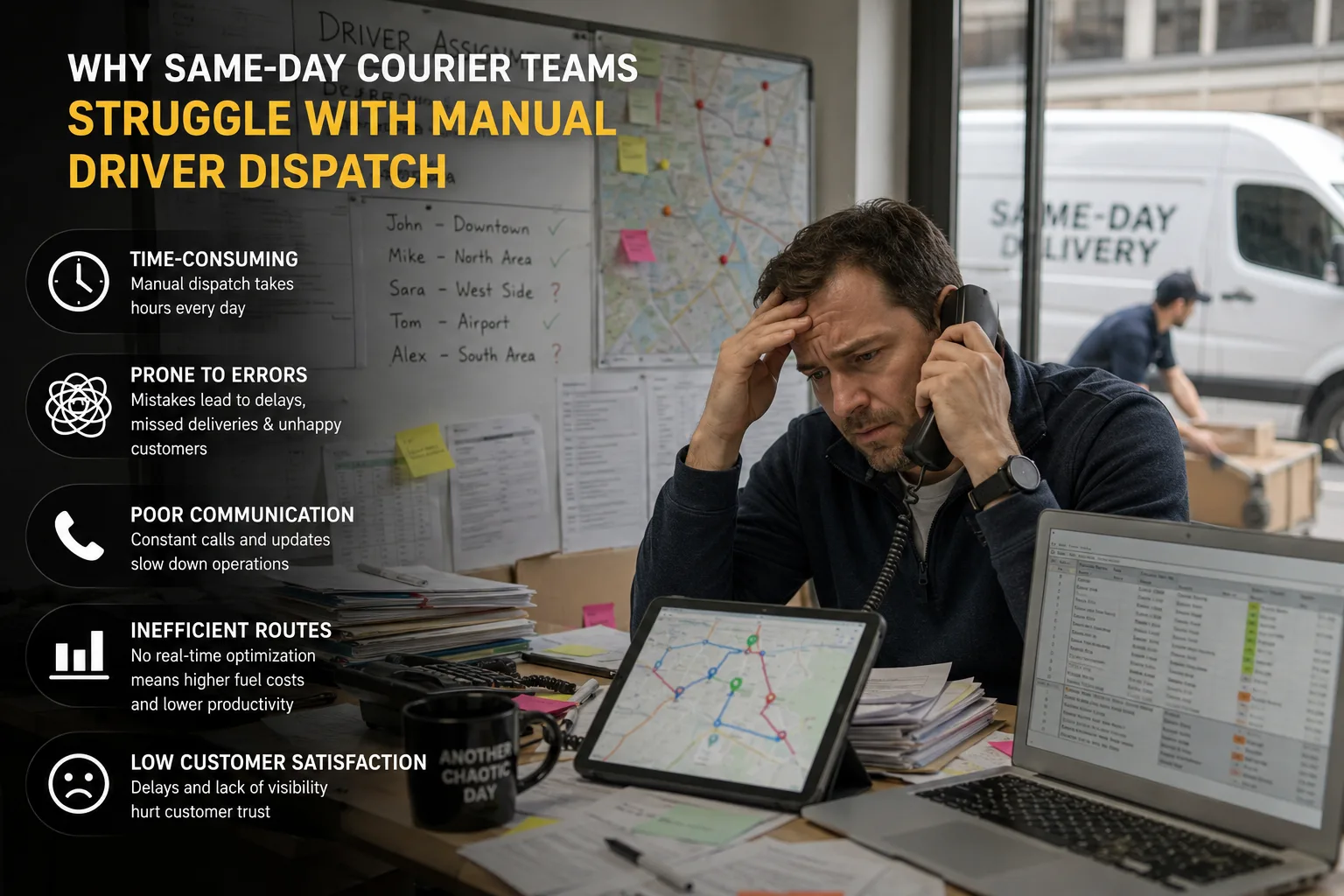

Same-day courier operations move quickly. A delivery request can come in at 10:00 AM and need to be collected, routed, delivered, confirmed, and reported within a few hours. For courier dispatch managers, transport planners, and operations teams, this leaves very little room for delays, confusion, or manual mistakes.
Yet many same-day courier companies still depend on manual driver dispatch. Jobs are assigned through phone calls, spreadsheets, WhatsApp messages, paper notes, whiteboards, and disconnected systems. These methods may feel familiar, but they can quickly become bottlenecks when order volume increases or urgent delivery requests arrive throughout the day.
Customers now expect faster booking, accurate ETAs, live tracking, status notifications, and reliable proof of delivery. Drivers need clear job details, route instructions, customer notes, and instant updates. Dispatchers need to know which driver is available, where they are, what job stage they are at, and whether a delivery is likely to be delayed.
Manual driver dispatch makes all of this harder to manage. It slows decision-making, increases admin work, reduces visibility, and creates more opportunities for errors. For same-day courier teams, where speed and accuracy are central to the service, manual dispatch can hold the entire operation back.
What Is Manual Driver Dispatch?
Manual driver dispatch is the process of assigning delivery jobs to drivers without a connected or automated dispatch system. Instead of using courier dispatch software or same-day delivery software, dispatchers manually decide which driver should handle each job.
This usually involves checking:
- Driver availability
- Driver location
- Vehicle type
- Delivery urgency
- Customer requirements
- Route knowledge
- Postcode or service area
- Current workload
- Collection and delivery time windows
The dispatcher may use spreadsheets, phone calls, text messages, WhatsApp groups, paper sheets, whiteboards, or separate systems to make these decisions.
In simple terms, manual driver dispatch means the dispatcher carries most of the operational logic in their head. They must know who is free, who is nearby, who is delayed, who can handle a specific job type, and who should receive the next urgent order.
For a very small courier team, this may work for a short time. But as same-day courier dispatch becomes busier, manual processes become slower, less reliable, and harder to scale.
Why Manual Dispatch Feels Manageable at First
Many courier teams start with manual dispatch because it feels simple. It does not require a new system, training, or process change. A dispatcher can take a call, write down the job, contact a driver, and confirm the delivery manually.
For small teams with a few drivers and predictable delivery areas, this can feel flexible. Dispatchers know the drivers personally, understand local routes, and can make quick decisions based on experience.
Manual dispatch often feels manageable when:
- Job volume is low
- The service area is limited
- Drivers are easy to contact
- Most jobs are similar
- Customers do not require frequent updates
- Proof of delivery is simple
- Reporting is not yet a priority
The challenge starts when the business grows. More drivers, more customers, more urgent jobs, more delivery zones, and higher customer expectations make manual dispatch harder to control.
At that point, the problem is not the dispatcher’s ability. The problem is that the process depends too heavily on memory, constant communication, and manual updates.
The Main Challenges Same-Day Courier Teams Face With Manual Driver Dispatch
1. Dispatchers Lose Time Assigning Jobs Manually
In same-day courier operations, speed matters. Every minute spent deciding which driver should take a job can affect collection times, delivery ETAs, and customer satisfaction.
With manual driver dispatch, dispatchers must check multiple details before assigning every job. They may need to call drivers, check spreadsheets, review delivery notes, estimate travel time, and confirm availability.
This becomes especially difficult during peak periods when several urgent jobs arrive at once. Instead of focusing on exceptions and service quality, dispatchers spend too much time on repetitive allocation decisions.
A manual process may require the dispatcher to ask:
- Which driver is closest?
- Is the driver actually available?
- Does the driver have enough capacity?
- Is the vehicle suitable?
- Will this job delay another delivery?
- Does the customer have special instructions?
- Is the delivery inside the driver’s normal area?
When all of this is handled manually, same-day courier dispatch becomes slower and more stressful.
2. It Is Hard to Choose the Right Driver Quickly
Manual driver allocation often depends on dispatcher memory or guesswork. A driver may appear available, but they may be too far away, already running late, or using the wrong vehicle type for the job.
In urgent delivery operations, choosing the wrong driver can create a chain reaction. A collection may be delayed, a delivery route may become inefficient, and another driver may need to be reassigned later.
The “right driver” is not always the driver who answers first. It may be the driver who is closest, has the correct vehicle, is moving in the right direction, has suitable capacity, and can meet the delivery deadline without disrupting existing jobs.
Courier dispatch software helps reduce this pressure by supporting driver allocation based on defined rules, location, availability, postcode, customer requirements, and operational priorities.
3. Manual Processes Increase Human Error
The more manual steps involved in dispatch, the higher the chance of mistakes.
Common manual dispatch errors include:
- Assigning the wrong driver
- Missing an urgent job
- Sending incomplete job details
- Entering the wrong address
- Duplicating an order
- Forgetting customer notes
- Failing to update delivery status
- Losing proof of delivery records
- Not informing the customer about delays
These mistakes are rarely intentional. They usually happen because dispatchers are working under pressure and information is spread across different tools.
For same-day courier teams, even small errors can create major operational problems. A missed collection, incorrect address, or delayed status update can affect customer trust and increase service team workload.
4. Dispatchers Lack Real-Time Visibility
Manual driver dispatch often leaves dispatchers with limited real-time visibility. They may not know exactly where a driver is, whether a job has been collected, whether a delivery is delayed, or whether the driver has completed the route.
This creates a visibility gap between the office, the driver, and the customer.
Without real-time driver tracking, dispatchers may need to call drivers repeatedly for updates. Customer service teams may also need to ask dispatchers for information before responding to customers.
This slows communication and creates frustration across the operation.
Real-time visibility is especially important for same-day courier companies because job status can change quickly. A driver may be delayed in traffic, a customer may not be available, or an urgent job may need to be inserted into an active route.
Delivery management software helps dispatchers monitor job progress, driver locations, delivery status, and route activity from one connected platform.
5. Route Planning Becomes Inefficient
Manual routing can lead to unnecessary mileage, longer delivery times, poor vehicle utilisation, and higher fuel costs.
A dispatcher may know the local area well, but planning routes manually becomes harder when there are multiple drivers, postcode zones, delivery windows, collection points, and last-minute changes.
Poor route planning can result in:
- Drivers crossing over each other’s areas
- Missed opportunities to group nearby jobs
- Longer travel times
- Higher fuel usage
- Lower driver productivity
- More late deliveries
- Less capacity for urgent jobs
Delivery route optimisation is important for both same-day and multi-drop courier work. It helps teams plan more efficient routes, reduce wasted mileage, and make better use of available drivers and vehicles.
InstaDispatch’s feature set includes route optimisation, ETA planning, smart mapping, run planning, auto allocation, driver app support, branded tracking, electronic proof of delivery, analytics, and reporting for delivery businesses.
6. Urgent Jobs Disrupt the Whole Schedule
Same-day courier teams regularly receive last-minute bookings. This is part of the service model. Customers often need urgent collections, time-sensitive deliveries, or immediate driver availability.
Manual dispatch makes these urgent jobs harder to manage because the dispatcher must rebalance the schedule manually.
A new urgent job may require the team to:
- Find the nearest suitable driver
- Check whether another driver can take over an existing job
- Recalculate timings
- Inform the customer
- Update the driver
- Adjust the route
- Monitor the impact on other deliveries
Without automated dispatch or connected planning tools, urgent work can disrupt the entire day. Drivers may receive conflicting instructions, existing deliveries may be delayed, and dispatchers may struggle to maintain control.
On-demand courier software helps by giving teams better visibility and faster decision-making when urgent orders arrive.
7. Communication Becomes Scattered
Manual dispatch often depends on communication across several channels. A dispatcher may use phone calls for urgent updates, WhatsApp for driver messages, email for customer notes, and spreadsheets for job tracking.
This creates scattered communication.
The problem is not only that information is spread out. The bigger issue is that different people may be working from different versions of the truth.
For example:
- The dispatcher may think a job is assigned
- The driver may not have accepted it
- The customer service team may not see the latest status
- The customer may not receive an update
- The proof of delivery may be stored separately
When communication is scattered, accountability becomes harder. It is more difficult to confirm what happened, when it happened, who updated the job, and whether the customer was informed.
A connected courier management software platform helps centralise job details, driver updates, tracking information, and delivery records.
8. Customers Expect Faster Updates
Modern customers do not want to call repeatedly to ask where their delivery is. They expect live tracking links, accurate ETAs, delivery status alerts, and proactive communication.
Manual driver dispatch makes this difficult because status updates depend on someone manually contacting the driver or updating the customer.
This can lead to common customer service issues:
- “Where is my delivery?”
- “Has the driver collected it?”
- “Why has my ETA changed?”
- “Can I track the driver?”
- “Has the delivery been completed?”
- “Can you send me proof of delivery?”
When customers do not receive timely updates, they contact the courier company. This increases call volume, distracts dispatchers, and puts pressure on the customer service team.
Same-day delivery software helps improve communication by supporting live tracking, ETA alerts, customer notifications, and delivery status visibility.
9. Proof of Delivery Is Harder to Manage
Proof of delivery is critical for courier businesses. It confirms that the delivery was completed and provides evidence in case of disputes.
Manual POD processes can create several problems:
- Paper PODs are lost
- Signatures are difficult to read
- Photos are delayed
- Delivery notes are incomplete
- Timestamps are missing
- Drivers forget to upload evidence
- Admin teams must manually match PODs to jobs
For same-day courier operations, delayed or missing proof of delivery can affect invoicing, customer confidence, and dispute resolution.
Electronic proof of delivery helps courier teams capture delivery evidence digitally. This may include signatures, photos, timestamps, delivery notes, and job history.
InstaDispatch supports electronic proof of delivery, customer signatures, delivery photographs, failed pickup and delivery attempt records, and complete route lifecycle history for operational control.
10. Reporting and Performance Tracking Are Limited
Manual systems make it difficult to measure performance accurately.
Courier businesses need to understand:
- How many jobs were completed
- Which jobs were delayed
- Why deliveries failed
- Which drivers are most productive
- How long deliveries take
- Which routes are inefficient
- Which customers generate the most urgent work
- Where costs are increasing
- Whether service levels are improving
When data is stored across spreadsheets, messages, paper notes, and separate systems, reporting becomes slow and unreliable.
Without clear reporting, courier teams may make decisions based on assumptions rather than operational evidence.
Delivery management software helps teams track delivery times, performance, customer satisfaction, and profitability insights in one place.
How Manual Dispatch Affects Same-Day Courier Profitability
Manual driver dispatch does not only affect daily operations. It can also reduce profitability.
When dispatchers spend too much time assigning jobs manually, admin workload increases. When routes are planned inefficiently, drivers travel more miles than necessary. When customers do not receive updates, customer service teams handle more calls. When proof of delivery is missing, disputes take longer to resolve.
The business impact can include:
- Higher admin workload
- More dispatcher stress
- Increased mileage and fuel costs
- Missed urgent delivery opportunities
- More failed or delayed deliveries
- Poorer customer experience
- Reduced driver productivity
- Harder scaling across customers, drivers, or regions
For example, a same-day courier company may receive five urgent jobs in the same city within one hour. If each job is assigned manually without real-time driver visibility or route optimisation, drivers may be sent across overlapping areas. One driver may travel too far for a collection while another nearby driver remains underused.
The result is wasted time, higher cost, slower service, and lower capacity for the next urgent job.
Manual dispatch may look inexpensive because it does not require software investment. But as delivery volume grows, the hidden cost appears in admin time, delivery delays, missed opportunities, customer complaints, and inefficient driver usage.
What Same-Day Courier Teams Need Instead
Same-day courier teams need a more connected and automated dispatch workflow.
This does not mean removing dispatcher control. It means giving dispatchers better tools to make faster, more accurate decisions.
Courier teams should look for same-day delivery software or courier dispatch software that supports:
- Automated driver allocation
- Real-time driver tracking
- Route optimisation and ETA planning
- Driver mobile app
- Customer booking portal
- Live delivery status updates
- Electronic proof of delivery
- Failed pickup and delivery attempt management
- Customer notifications
- Analytics and reporting
- E-commerce, API, and courier network integrations
The goal is to reduce repetitive manual work, improve visibility, and help dispatchers manage exceptions instead of chasing every update manually.
How Automated Dispatch Helps Same-Day Courier Operations
Faster Driver Allocation
Automated dispatch can assign jobs based on operational rules such as postcode, city, customer, driver availability, and proximity.
Instead of manually checking every driver, dispatchers can use allocation rules to speed up job assignment. This is especially useful for urgent delivery operations where response time matters.
InstaDispatch supports auto allocation of same-day and urgent delivery jobs to drivers or agents using rules based on customer, postcode, or city. It also supports auto broadcast of eligible jobs to selected drivers, where the first driver to accept gets the job.
Better Route Efficiency
Route optimisation helps drivers complete more jobs with less wasted mileage.
For same-day courier teams, route efficiency is not only about saving fuel. It also affects delivery speed, driver productivity, and the ability to handle extra urgent jobs during the day.
With better route planning, courier companies can reduce unnecessary travel, group nearby deliveries more effectively, and improve vehicle utilisation.
Real-Time Operational Control
Automated dispatch and real-time tracking give dispatchers a clearer view of live operations.
They can see job progress, driver locations, delivery status, delays, and completed work from one system. This helps teams respond faster when something changes.
For example, if a driver is delayed, the dispatcher can see the issue earlier and decide whether to reassign a job, update the customer, or adjust the schedule.
Improved Customer Experience
Customers expect communication. Same-day courier teams that provide tracking links, ETA alerts, and delivery status updates can reduce customer uncertainty.
Better communication also reduces “Where is my delivery?” calls.
InstaDispatch supports branded tracking pages, whitelabelled notifications, WhatsApp communication, and real-time ETA alerts with live tracking links.
Stronger Delivery Accountability
Electronic POD helps courier companies keep clear delivery records.
Signatures, photos, timestamps, notes, failed attempt records, and job history make it easier to confirm what happened during a delivery. This helps reduce disputes and gives customers more confidence.
For dispatchers and managers, digital records also improve internal accountability because delivery evidence is connected to the job.
Easier Scaling
Manual dispatch often becomes harder as the business grows. More drivers, customers, jobs, and regions create more manual coordination.
Courier management software helps teams scale without increasing admin workload at the same rate. Dispatchers can manage more work because job assignment, tracking, customer updates, POD capture, and reporting are handled through a connected workflow.
This makes growth easier to control.
Also Read: How to Choose the Best Route Optimization Software for Delivery Teams
Signs Your Courier Team Has Outgrown Manual Dispatch
Your courier team may have outgrown manual driver dispatch if:
- Dispatchers spend too much time assigning jobs
- Drivers frequently call for updates
- Customers often ask, “Where is my delivery?”
- Urgent jobs regularly disrupt planned routes
- Proof of delivery is delayed or missing
- Spreadsheets are becoming hard to maintain
- Delivery costs are rising
- Drivers are travelling unnecessary miles
- You lack clear reporting on performance
- Your team struggles during peak periods
- Job updates are spread across too many channels
- You want to scale same-day delivery operations
If several of these signs are familiar, the issue is likely not just workload. It may be a process limitation.
Why InstaDispatch Is Built for Same-Day Courier Teams
InstaDispatch is built to help courier businesses manage same-day and on-demand delivery operations from order creation to dispatch, tracking, proof of delivery, customer communication, and reporting.
For same-day courier teams, InstaDispatch supports a more connected workflow across:
- Same-day delivery management
- Smart mapping and run planning
- Auto allocation of orders to drivers
- Auto broadcast of eligible jobs to drivers
- Multidrop route support
- Driver app with navigation support
- Real-time tracking and ETA alerts
- Electronic proof of delivery
- Customer portal and branded tracking
- Analytics and reporting
- API and e-commerce integrations
This helps courier teams reduce manual admin, improve driver allocation, keep customers updated, and maintain better visibility across urgent delivery operations.
The platform is positioned for same-day, on-demand, last-mile, courier, and delivery businesses, with features such as order input, recurring bookings, quotations, multi-drop order creation, smart mapping, route planning, auto allocation, driver navigation, branded tracking, customer notifications, electronic proof of delivery, failed attempt management, and analytics.
Conclusion
Manual driver dispatch may work for very small courier teams, but it becomes a major barrier as same-day delivery operations grow.
As job volume increases, dispatchers need more than spreadsheets, calls, WhatsApp messages, and manual notes. They need real-time visibility, faster driver allocation, delivery route optimisation, automated dispatch, customer updates, and reliable proof of delivery.
For same-day courier companies, the goal is not to replace dispatcher expertise. The goal is to support dispatchers with better systems so they can work faster, reduce errors, manage urgent jobs confidently, and deliver a better customer experience.
Explore InstaDispatch Same Day Delivery Software to see how your courier team can simplify dispatch, improve driver allocation, and manage urgent deliveries with confidence.
