
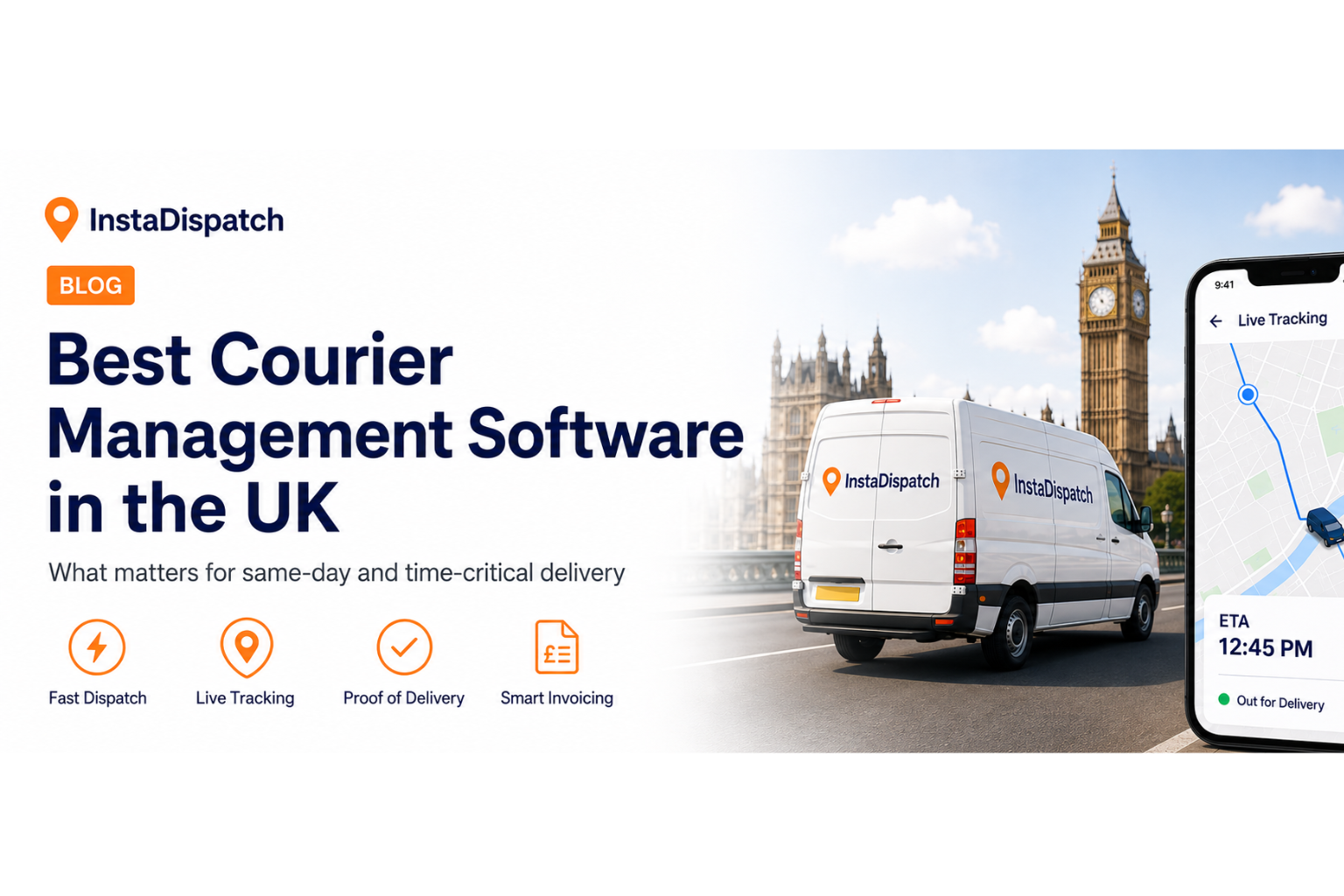

It’s 2pm. A client rings: the consignment that had to be signed for by noon still isn’t there, and they want answers you don’t have. If that scenario makes your stomach drop, you already know why picking the best courier management software in the UK is a decision worth getting right. In same-day and time-critical work, the platform you run on is the line between a calm control room and a day spent firefighting — the right courier management software doesn’t just log jobs, it buys back the minutes that keep those promises. InstaDispatch’s courier management software is a useful yardstick for what an all-in-one platform should actually cover.
And the stakes are hard cash. Failed deliveries drain around £1.6 billion a year from UK retailers, with roughly 8% of domestic deliveries missing on the first attempt, according to Pegasus Couriers — and in same-day, there’s rarely a second attempt to save you. This guide skips the feature-list noise and gets to what matters: what separates a genuinely great platform from an average one, the capabilities that count when the clock is running, and a checklist to help you choose the right fit.
What is courier management software?
Courier management software is a single platform for running a delivery business end to end — bookings, dispatch, route planning, live tracking, proof of delivery and invoicing — instead of duct-taping spreadsheets, phone calls and separate apps together. For same-day and time-critical operators, it’s the nerve centre that keeps dispatchers, drivers and customers all on the same live picture.
Why same-day and time-critical delivery raises the stakes
In time-critical delivery, the best courier management software is the one that strips minutes and manual decisions out of every job — because there’s no second attempt to bail you out.
Speed is now the product. The UK same-day delivery market was worth around USD 4.3 billion in 2025 and is on track for roughly 10% annual growth, pushing past USD 11 billion by 2035, according to Expert Market Research — driven by quick commerce, pharmacy runs and healthcare logistics. As those volumes climb, the manual workarounds that coped at 30 jobs a day quietly collapse at 130. If most of your work is urgent, purpose-built same-day delivery software — with instant allocation, postcode quoting and live ETAs — will beat a generic tool bent into shape for speed.
What’s changed in 2026 — and why it matters when you buy
A few shifts are rewriting what “best” means on a shortlist this year. Buy for where delivery is heading, not where it was.
- AI-assisted dispatch and route orchestration. Allocation and routing are increasingly automated rather than decided by hand, so favour platforms with rules-based auto-allocation and traffic-aware optimisation baked into the core — not bolted on later.
- Quick commerce is squeezing the windows. Grocery, pharmacy and B2B express are normalising one- and two-hour promises, which makes postcode quoting, daily capacity limits and live ETAs matter more than they did a year ago.
- Electrified urban fleets and cargo bikes. As vans give way to e-bikes in city centres, your software needs to match each job to the right vehicle type and run a mixed fleet without workarounds.
- “Fully tracked” is the new default. Customers now assume live tracking and a proof-of-delivery record as standard, so a branded tracking page and instant ePOD are table stakes, not premium add-ons.
The features that separate the best from the rest
The best courier management software UK operators trust tends to share the same core. Here’s what to insist on — and why each earns its place when the clock is running.
- Automated dispatch and driver allocation. Rules that assign each job to the nearest available driver — or one within range of the collection point — remove the single biggest bottleneck in same-day: a human deciding who goes where, job by job.

- Real-time tracking and customer ETAs. Live driver locations on a map, with automatic status updates and ETAs pushed to customers, kill the “where’s my parcel?” calls that swamp dispatch — and warn you early when a job is slipping.

- Route optimisation and mid-shift re-planning. Multi-drop routes that account for traffic, time windows and vehicle type save fuel and fit more slots into a shift — and re-optimise when an urgent job lands mid-round.
- Offline electronic proof of delivery (ePOD). Signature, photo, notes, GPS and timestamp captured on the driver’s phone and synced instantly — including offline, because UK rounds hit dead zones — is your defence against disputes and the data your invoicing runs on.

- A branded customer booking portal. A portal where clients place and track their own orders removes email and WhatsApp bookings, and makes a small operation look as sharp as a national carrier.

- Invoicing and rate cards. Invoices generated from real delivery data, with per-customer rate cards, keep finance in the same system as operations. A routing-only tool that can’t bill leaves you re-keying every job.
- Integrations that fit UK operations. Carrier links (DHL, DPD, UPS, Parcelforce), e-commerce (Shopify, WooCommerce, Amazon, Magento) and accounting (QuickBooks) stop manual data entry — and Courier Exchange / same-day exchange integration matters more here than any global feature.

- Reporting and SLA analytics. Delivery success, on-time performance and exceptions at a glance, so you can prove SLA compliance to clients and find the routes quietly losing you money.
- UK-based support and data compliance. When a job goes wrong at 4pm on a Friday, a support team in your timezone matters — and UK GDPR-aligned handling of addresses, signatures and delivery photos keeps you on the right side of the rules.
Match the software to your delivery model
The “best” platform depends on what you actually deliver. Weigh features against your model rather than a generic checklist.
| Delivery model | Where it gets hard | Features to prioritise |
|---|---|---|
| Same-day / on-demand | No second attempt; tight windows | Auto-allocation, live tracking, instant ePOD, postcode quoting |
| Last-mile / high volume | Many drivers, tight SLAs | Route optimisation, hub scanning, failed-attempt tracking, ETA alerts |
| Multi-drop | Sequencing and mid-shift replans | Multi-drop optimisation, geofencing, in-app stop sequencing |
| White-glove / 2-man | Scheduling, care, add-ons | Slot booking, daily capacity limits, damage-free POD, add-on services |
| Time-critical (medical/legal) | Chain of custody and proof | OTP-verified handover, geo-tagged POD, audit-ready reporting |
Your 8-point buyer’s checklist
Work through these before you sign anything — they’ll save you from buying the wrong tool well.
- Map your real workflow first. Write down how a job moves today — booking, allocation, routing, POD, invoicing — and where it breaks. Buy for the breaks, not the brochure.
- Separate must-haves from nice-to-haves. Lock down the non-negotiables (offline ePOD, auto-allocation) so a slick demo can’t upsell you on the wrong things.
- Trial with your own data. A free trial only tells you something if you run your real routes, drivers and customers through it — not the vendor’s tidy demo set.
- Put the driver app in a driver’s hands. Your drivers, not your dispatchers, decide whether a system gets used. Test it in a low-signal area.
- Check the integrations you depend on. Confirm your carriers, sales channels and accounting tool connect properly before you commit, not after.
- Interrogate the pricing. Look for transparent, usage-based pricing with no long lock-in, and check what happens when volumes spike at peak.
- Pressure-test support and onboarding. Ask how migration works, who owns setup, and what UK support looks like when a job goes wrong at 4pm on a Friday.
- Pilot on your worst route. If it fixes your most painful round, the easy ones take care of themselves.
Mistakes that cost UK couriers most
A handful of recurring errors cost operators far more than the software ever does.
- Buying on headline price alone. The cheapest tool that can’t bill, or that drivers won’t use, becomes the expensive one once you count the rework.
- Ignoring the driver app. If it’s clunky, drivers work around it, your data goes patchy, and your tracking and invoicing suffer downstream.
- Underestimating onboarding. A powerful platform set up badly performs worse than a simple one configured well. Budget real time for migration and training.
- Choosing a routing-only tool. Route optimisation is vital, but if you also need dispatch, POD, a portal and invoicing, a point tool leaves gaps you’ll fill by hand.
- Skipping the real-data trial. A demo that looks perfect on sample data can fall apart on your messy, real-world rounds.
Where InstaDispatch fits
InstaDispatch is a UK-focused, cloud-based platform that covers the full lifecycle in one system — online booking, dispatch, route planning, live tracking, offline ePOD, a branded customer portal and invoicing — with same-day and multi-drop support, Courier Exchange integration and usage-based pricing. For same-day and time-critical operators who want control from booking to invoice without stitching tools together, that’s exactly the job it’s built for. Book a demo and start a free trial to run your own routes through it, or dig into the same-day delivery software if urgent work is your bread and butter.
