Parcel Delivery Software
Parcel Delivery Software for High-Volume, Last-Mile Operations
A single operational platform for UK courier & delivery businesses.
If you’re still dispatching parcels from a spreadsheet, chasing drivers for delivery updates, or juggling four separate carrier portals — this page is for you. Parcel delivery software replaces that fragmented setup with a single platform that handles dispatch, routing, real-time tracking, proof of delivery, and invoicing from one screen.
This guide covers what the software does, what to look for when choosing it, and how businesses like yours are using it to run leaner, faster operations.
LIVE OPERATIONS
One queue, every job
Orders received
E-commerce and UK transport exchanges jobs flow into one dispatch queue.
Route optimised
Efficient multi-drop sequencing for every driver.
DISPATCHED
Driver 12 · parcel tracked live
DELIVERED
ePOD signature & photo captured
Parcel & last-mile
InstaParcel
Our own parcel service, InstaParcel, runs on InstaDispatch. Read the GigiGo story →
Customer Stories
Brands That Trust Us
We push every boundary to ensure that instaDispatch courier dispatch software brings efficiency to our client's business. For us every customer who comes on board must become a success story.


FREIGHT
FINDERS
FINDERS
📦 Hitra
Pošta
Pošta
GLAM
RapidWheels
LOGISTICS
LOGISTICS
REFLEX
The essentials
What Is Parcel Delivery Software?
A cloud-based platform that manages the end-to-end journey of every parcel — from booking through to invoicing.
Definition and core purpose
Parcel delivery software is a cloud-based platform that manages the end-to-end process of sending, routing, tracking, and confirming delivery of parcels. It sits between your order source (an e-commerce store, a customer booking, or a load board like UK transport exchanges) and your driver or carrier network — automating the steps that would otherwise require manual input at every stage.
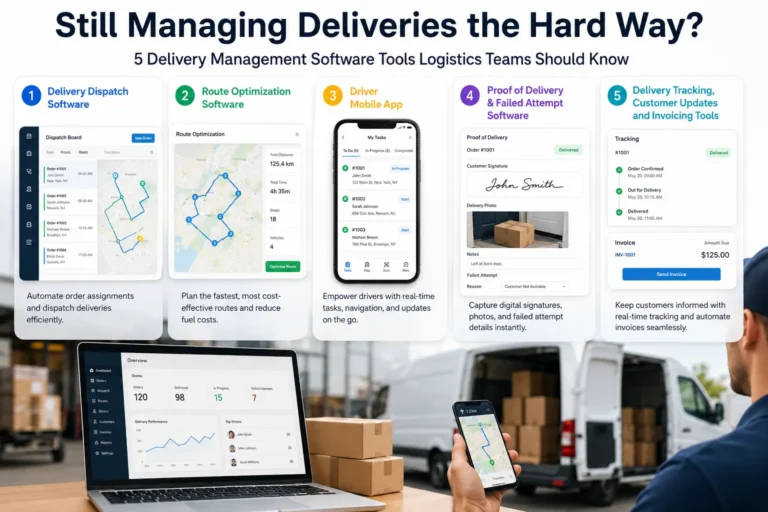
At its core, a modern parcel delivery management platform does five things: it receives and assigns delivery jobs, optimises routes for drivers, tracks those drivers in real time, captures proof of delivery electronically, and generates invoices based on completed jobs. Some platforms also provide white-label tracking portals so your customers can follow their own parcels without calling your office.
- Receives & assigns jobs — inbound from stores, bookings and load boards, matched to drivers
- Optimises driver routes — efficient multi-drop sequencing for every run
- Real-time tracking — live driver visibility across the whole fleet
- Electronic proof of delivery — signature, photo, GPS and timestamp captured at the door
- Automated invoicing — invoices generated from completed jobs on your rate cards
- White-label tracking portals — customers follow their own parcels without calling your office
Why it matters for e-commerce and courier SMEs
For small and mid-market operators, the operational drag of manual dispatch is significant. Every job that gets manually typed, every driver update that comes via WhatsApp, every invoice that gets built in Excel — that’s overhead that doesn’t scale. As order volumes grow, the gaps between systems multiply: a customer chases a delivery your driver marked complete but your back office never recorded; an invoice goes out three days late because billing is disconnected from dispatch.
Parcel delivery software closes those gaps. It creates a single source of truth for every job, from booking through to invoicing, and gives e-commerce retailers and courier companies the visibility and control they need to grow without hiring proportionally more admin staff.
Core Features
Core Features of Modern Parcel Delivery Software
These are the capabilities that matter for courier, e-commerce and 3PL operators — the automation that replaces manual dispatch, fragmented tracking and disconnected billing.
01
Automated Dispatch & Load Assignment
Modern platforms accept jobs from multiple input channels — manual entry, CSV import, API feeds from e-commerce stores, or direct integration with load boards like UK transport exchanges — and assign them to drivers based on rules you configure: proximity, vehicle type, availability, or customer SLA. Automated dispatch removes the bottleneck of a single controller manually matching jobs to drivers and reduces the risk of human error in allocation.
02
Route Optimisation for Faster Deliveries
Route optimisation calculates the most efficient delivery sequence for each driver’s job list, factoring in time windows, vehicle capacity, traffic data, and geographic clustering. For a driver doing 25 drops in a day, even a 10–15% reduction in total mileage adds up to meaningful fuel savings and faster completion times. Good route optimisation also helps with same-day delivery windows, where tight deadlines make sequencing critical.
03
Real-Time Driver Tracking & Notifications
GPS tracking through the driver app gives dispatchers a live map view of every vehicle on the road. Beyond internal visibility, the best platforms use that tracking data to send automated customer notifications — an SMS or email when a driver is on the way, with a live tracking link. This single feature dramatically reduces inbound customer queries about delivery status and lifts customer satisfaction scores.
04
Electronic Proof of Delivery (ePOD)
ePOD replaces paper delivery notes with a digital capture at the point of delivery: customer signature, photo of the parcel at the door, GPS coordinates, and timestamp — all recorded on the driver’s smartphone and synced to the platform in real time. This creates an irrefutable delivery record that can be attached to invoices, shared with customers, and retrieved instantly in the event of a dispute.
05
Multi-Carrier Integration
Rather than logging into each carrier’s own portal, a parcel delivery platform integrates directly with your carrier accounts. You can book shipments, print labels, and track delivery status for DHL, DPD, UPS, FedEx, Parcelforce, APC, Yodel, DX, and others from a single interface. For UK operators, direct integration with UK transport exchanges are particularly valuable — it allows jobs from the exchange to flow directly into your dispatch workflow without manual re-keying.
06
E-Commerce Platform Integration
For e-commerce retailers running their own delivery operation, the ability to pull orders directly from Shopify, WooCommerce, Linnworks, BigCommerce, or Shiptheory means zero manual order entry. Orders appear in the dispatch queue automatically, with customer details, delivery address, and any special instructions already populated. Shipping status updates flow back to the storefront, keeping customers informed without manual intervention.
07
Automated Invoicing & Billing
Once a job is complete, parcel delivery software can generate an invoice automatically using your pre-set rate cards — by distance, zone, parcel weight, or service type. Consolidated invoicing for customers with regular accounts, fuel surcharge calculations, and integration with accounting platforms like Xero, QuickBooks, or Sage means your billing cycle stays close to your delivery cycle, reducing payment delays and revenue leakage.
08
White-Label Customer Portals
For 3PLs and courier businesses serving branded customers, white-label portals let your clients log in under your brand to place bookings, track their deliveries in real time, and download their own invoices and ePOD records. This reduces the volume of inbound queries your team handles and positions you as a more professional, technology-enabled operator — which matters when you’re competing for contract renewals.
Automated Dispatch & Load Assignment
Automatically assign incoming jobs by driver location, vehicle type, availability and SLA rules to reduce manual work and allocation errors.
Route Optimisation for Faster Deliveries
Optimise multi-stop routes using delivery windows, capacity, traffic and location data to reduce mileage, fuel costs and delivery times.
Real-Time Driver Tracking & Notifications
Track drivers live and automatically send customers SMS or email updates, ETAs and tracking links throughout the delivery.
Electronic Proof of Delivery (ePOD)
Capture signatures, delivery photos, GPS coordinates and timestamps digitally for instant, reliable proof of every completed delivery.
Multi-Carrier Integration
Manage bookings, labels and tracking across multiple carriers from one platform, including direct UK transport exchanges workflow integration.
E-Commerce Platform Integration
Import orders automatically from Shopify, WooCommerce and other platforms, removing manual entry and keeping delivery statuses synchronised.
Automated Invoicing & Billing
Generate invoices from completed jobs using rate cards, surcharges and service rules, with accounting integration for faster billing.
White-Label Customer Portals
Give customers a branded portal to book deliveries, track jobs and access invoices or ePOD records without contacting your team.
Use Cases
Common Use Cases for Parcel Delivery Software
E-Commerce Retailers Managing Their Own Fleet
A growing Shopify or WooCommerce retailer that has brought delivery in-house needs to connect their order management system to their driver operation without building custom integrations. Parcel delivery software provides that connection out of the box — orders pull in automatically, drivers are dispatched with optimised routes, customers get tracking links, and ePOD records close each job. The retailer maintains full control of the delivery experience without the overhead of manual coordination.
Independent Couriers Consolidating Jobs
A small courier company running five to fifteen drivers needs visibility across all active jobs without a full-time controller glued to a phone. Automated dispatch and route optimisation mean drivers can start earlier, complete more drops, and spend less time driving inefficient routes. The platform handles customer notifications automatically, so the office isn’t fielding tracking calls all day.
Freight Forwarders Managing Mixed Shipments
Freight forwarders managing a mix of parcel, express, and pallet shipments across multiple carriers benefit from a single platform that tracks all shipment types in one view. Multi-carrier booking and consolidated invoicing reduce the administrative overhead of working across DHL, UPS, Parcelforce, and own-account vehicles simultaneously.
3PL Providers Serving Multiple Clients
Third-party logistics providers managing deliveries on behalf of multiple retail or wholesale clients need to keep those clients’ data separate and present a professional, branded interface. White-label customer portals mean each client logs in to their own branded tracking environment, while the 3PL manages everything from a single back-end system. Consolidated billing and per-client reporting simplify account management significantly.
Logistics Firms Integrating UK transport exchanges Jobs
UK courier businesses active on UK transport exchanges often handle both their own contract work and spot jobs from the exchange. Without software integration, exchange jobs have to be manually re-entered into the dispatch system — a time-consuming step that introduces errors and delays. A platform with native transport exchange integration pulls those jobs in automatically, so they sit alongside contract work in the same dispatch queue, with the same tracking and ePOD workflow applied.
ROI & Implementation
Implementation and ROI Timeline
Here is the timeline most SME courier and parcel operators can expect — from go-live through to payback.
1–5 days
Typical time to go live
Basic setup — adding drivers, configuring rate cards, connecting carrier accounts, and integrating an e-commerce platform — doesn’t require a developer. More complex configurations may take a week or two longer. Legacy or enterprise systems routinely take three to six months.
30–50%
Fewer tracking calls
Automating job allocation removes a manual bottleneck from day one. Automated ‘driver en route’ notifications typically reduce inbound tracking calls by 30–50% within the first week, and drivers complete more drops per day within the first route cycle.
1–3 months
Compounding gains
Route optimisation, reduced failed deliveries, and faster invoicing cycles compound into meaningful financial gains. Fuel costs fall as mileage efficiency improves, payment cycles shorten as invoices go out the same day, and driver utilisation improves as controllers shift to exception management.
4–8 weeks
Typical ROI payback
For a courier company running ten or more drivers, the subscription cost is typically recovered within four to eight weeks through a combination of fuel savings, reduced admin hours, faster invoice collection, and fewer failed-delivery redeliveries. Higher volumes tend to see faster payback.
Getting Started
Getting Started with Parcel Delivery Software
01 · Assess your current workflow and pain points
Before evaluating platforms, spend an hour mapping your current dispatch process end to end — from order receipt to invoice. Note every manual step, every tool involved, and every point where things regularly go wrong. This gives you a clear picture of what the software needs to replace or improve, and a baseline against which you can measure the impact after go-live.
02 · Map required integrations
List every external system the platform needs to connect with: your e-commerce store (Shopify, WooCommerce, Linnworks), the carriers you book through (DHL, DPD, Parcelforce, UK transport exchanges), and your accounting software (Xero, QuickBooks, Sage). Prioritise platforms that support all of these natively, or that offer an open API for anything custom. Integrations that require manual workarounds will become friction points at scale.
03 · Test it on your own use case: a free trial on your own jobs shows more than any walkthrough
Generic software demos show features. A good demo shows how those features work for your specific operation. When you speak with a vendor, tell them your daily delivery volume, the carriers you use, your e-commerce platform, and your biggest current pain point — and ask them to walk through exactly how their platform handles that scenario. If they can’t demo your use case, that’s informative.
04 · Test with a pilot week or subset of operations
Most SaaS platforms offer a free trial or a low-commitment pilot period. Use it on a real subset of your operations — a specific driver team, a specific customer account, or a specific carrier integration — rather than running it in parallel with everything else. A real-world pilot surfaces practical issues (driver app usability, integration edge cases, notification timing) that a demo never will.
05 · Plan rollout and driver training
Driver adoption is the most common implementation risk. If drivers don’t use the app consistently — especially for ePOD capture — the back-office benefits don’t materialise. Build a short, practical training session into your rollout plan: show drivers the app on their own phone, walk through a job from assignment to delivery confirmation, and address any concerns about battery or data usage. Most drivers adapt quickly when they see the app is straightforward and makes their day easier.
Why InstaDispatch for Parcel Delivery Management
InstaDispatch is a cloud-based parcel and courier delivery management platform built specifically for SME and mid-market logistics operators. It covers the full delivery workflow — automated dispatch, route optimisation, real-time driver tracking, ePOD, customer notifications, white-label portals, and integrated invoicing — in a single platform with transparent, usage-based pricing and no long-term contract lock-in.
To see how InstaDispatch handles your specific operation, Start free trial or explore all InstaDispatch features. If you’re comparing platforms, the delivery management software overview and courier management software page cover the platform in more detail.
Key reasons UK courier and parcel operators choose InstaDispatch:
- UK-based support team — available during UK business hours, with direct knowledge of the UK courier sector
- native transport exchange integration — exchange jobs flow directly into your dispatch queue without manual re-keying
- Multi-carrier support — DHL, DPD, UPS, FedEx, Parcelforce, APC, Yodel, DX, and more from one interface
- E-commerce integrations — Shopify, WooCommerce, Linnworks, BigCommerce, and Shiptheory connect in minutes
- Fast setup — most operators are live within one to three days; no IT team required
- White-label portals — give every client their own branded tracking and booking experience
- Automated invoicing — billing generates from completed jobs; syncs with Xero, QuickBooks, and Sage
- Operates in 50+ countries — built for UK operations, available globally
FAQ
Frequently Asked Questions
What is parcel delivery software used for?
Parcel delivery software manages the end-to-end process of dispatching, routing, tracking, and confirming delivery of parcels. It’s used by courier companies, e-commerce retailers with their own delivery fleet, 3PL providers, and freight forwarders to automate job allocation, optimise driver routes, capture electronic proof of delivery, send customer tracking notifications, and generate invoices — all from a single platform.
How is parcel delivery software different from a carrier portal?
A carrier portal (such as the DHL or Parcelforce booking portal) is designed to manage shipments exclusively through that carrier. Parcel delivery software sits above the carrier layer — it integrates with multiple carriers simultaneously, manages your own driver fleet, handles dispatch and routing, captures ePOD under your brand, and consolidates billing across all delivery channels. If you use more than one carrier, or run any own-account drivers, dedicated delivery software gives you a level of control and visibility that carrier portals cannot.
How long does it take to set up parcel delivery software?
Cloud-based parcel delivery SaaS can typically be set up within one to five days for a standard SME operation. Adding drivers, configuring rates, connecting carrier accounts, and integrating an e-commerce platform like Shopify or WooCommerce doesn’t require technical expertise. More complex configurations — such as multi-depot management or custom integrations — may take a week or two longer, but still a fraction of the months required for legacy or enterprise TMS implementations.
Does parcel delivery software integrate with Shopify and WooCommerce?
Yes. Most modern parcel delivery platforms — including InstaDispatch — integrate directly with Shopify, WooCommerce, and other e-commerce platforms such as Linnworks and BigCommerce. Orders placed on your store are pulled into the dispatch queue automatically, drivers are assigned and routed, and shipping status updates flow back to the storefront to keep customers informed. This eliminates manual order entry and the errors that come with it.
What is electronic proof of delivery (ePOD) and why does it matter?
Electronic proof of delivery (ePOD) replaces paper delivery notes with a digital record captured on the driver’s smartphone at the point of delivery. This includes the recipient’s signature, a photo of the parcel at the delivery location, GPS coordinates, and a timestamp. The record is synced to the platform instantly and stored against the job. ePOD matters because it eliminates delivery disputes, provides an irrefutable audit trail, can be attached directly to customer invoices, and is retrievable in seconds — rather than hunting through a stack of paper notes.
Is parcel delivery software suitable for small courier companies?
Yes. Cloud-based parcel delivery SaaS is particularly well suited to small and independent courier operators. The setup is fast, the pricing is usage-based so costs scale with your volume, and there’s no requirement for dedicated IT staff to maintain the system. For a small courier company running two to ten drivers, the main gains are in dispatch speed, route efficiency, automated customer notifications, and professional invoicing — all of which are accessible from day one without a large upfront investment.
Can parcel delivery software handle same-day deliveries?
Yes, and same-day delivery is one of the core use cases the software is built for. Same-day operations require fast job allocation, real-time driver tracking, and tight route sequencing — all of which are core features of a modern parcel delivery platform. For UK operators, platforms with native transport exchange integration are particularly useful for same-day jobs, as exchange work can be accepted and dispatched directly within the platform without manual intervention.
What’s the typical cost of parcel delivery software?
Pricing varies by platform and by volume, but cloud-based parcel delivery SaaS is generally priced either per delivery, per driver seat per month, or as a combination. Usage-based pricing is common and suits operators with variable volumes. For SME operators, monthly costs typically range from a few dozen pounds for low-volume operations to a few hundred pounds for companies processing hundreds of deliveries per day. The key thing to verify is what’s included in the base price — some platforms charge separately for ePOD, customer notifications, integrations, or support.
Our Insights