
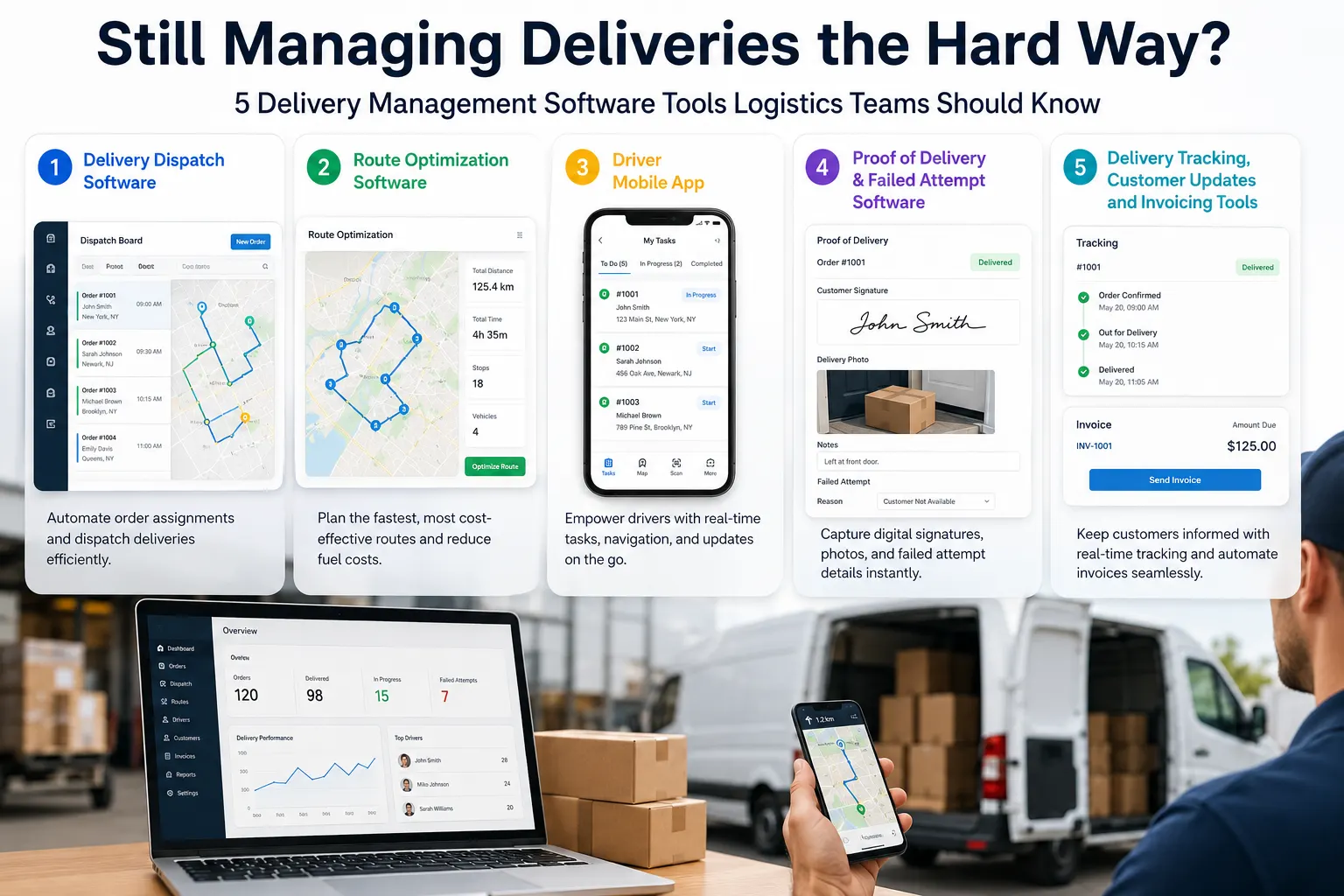

Most delivery operations do not come unstuck because of bad drivers or bad routes. They come unstuck because the information about those drivers and routes is scattered across six places at once: a whiteboard, a WhatsApp group, a spreadsheet, a shoebox of paper delivery notes, the accounts inbox and the dispatcher’s memory. It works at forty drops a day. At two hundred it starts to leak money quietly, and by the time you notice, you are already firefighting. The right delivery management software tools close those gaps by putting booking, dispatch, routing, driver activity, proof and invoicing into one connected workflow instead of five disconnected ones.
This guide breaks down the five tool categories that matter most for UK courier and same-day operators, what each one actually fixes, and how to tell whether you need five separate products or one platform. If you want the full picture first, InstaDispatch sets out how the pieces fit together on its delivery management software page.
Why the manual method stops working sooner than you think
The short answer: parcel volumes and customer expectations have both risen faster than most dispatch desks have been re-tooled. Manual coordination scales linearly — more jobs means more phone calls — while software scales flat.
The scale of UK delivery is easy to underestimate. Ofcom’s postal monitoring data records around 4.2 billion parcels handled across the UK market in 2024–25, up from roughly 3.9 billion the year before, and the same research found that a substantial majority of consumers had run into a delivery problem in the previous six months (Ofcom, Post Monitoring Report). Meanwhile, Department for Transport figures put van traffic at 58.8 billion vehicle miles in 2025 — around 10% above pre-pandemic levels and roughly 18% of all motor vehicle traffic on Great Britain’s roads (DfT, Road traffic estimates in Great Britain). More vans, more stops, more congestion, tighter windows.
Then there is the cost of getting it wrong. Failed first-time deliveries are estimated to cost UK retailers in the region of £1.6 billion a year, at an average of about £11.60 per failed attempt once redelivery, fuel, admin and customer service time are counted (Pegasus Couriers, The cost of failed deliveries). For an operation running 300 drops a day at a 6% failure rate, that is roughly £200 of avoidable cost every single day — before you count the customer who does not come back.
What the spreadsheet-and-WhatsApp method really costs
- Dispatcher time. Planning and re-planning by hand eats two to three hours a day that should be spent on exceptions and customer calls.
- Fuel and mileage. Routes built by instinct rather than by drive time almost always carry avoidable miles.
- Disputes. Without timestamped, geotagged proof, a “we never received it” claim is your word against theirs.
- Invoicing leakage. Waiting time, surcharges and extra drops get forgotten between the driver, the whiteboard and the accounts spreadsheet.
- Customer service load. Every “where is my parcel?” call is a cost you only pay because the customer had no other way to find out.
What delivery management software tools actually do
Delivery management software tools are the systems that plan, assign, track, prove and bill a delivery from the moment an order arrives to the moment the invoice is raised. In practice they replace manual coordination with a single operational record that dispatchers, drivers, customers and the accounts team all read from.
It helps to think of them as five layers rather than five products. Each layer answers a different operational question:
| Layer | Tool category | The question it answers |
|---|---|---|
| Control | Delivery dispatch software | Who is doing this job, and when? |
| Cost | Route optimization software | What is the cheapest, fastest order of stops? |
| Field | Delivery driver app | What does the driver see and do on the road? |
| Evidence | Proof of delivery software | Can we prove the job was completed properly? |
| Trust | Tracking and notifications | Does the customer need to ring us to find out? |
The five delivery management software tools every UK logistics team should know
1. Delivery dispatch software — the control layer
Delivery dispatch software is the operational spine. It takes bookings from every channel — a customer portal, a phone call, an API, a Shopify or Amazon store, a bulk CSV upload — and turns them into assignable jobs on one board, then allocates each one to a driver by location, vehicle type and availability.
The gain is not glamorous, but it is the biggest single win most operations make: your dispatcher stops being a switchboard. Auto-allocation to the nearest suitable driver, drag-and-drop reassignment and a live board covering every open and completed task remove the endless ring-round. In a same-day business, where a job booked at 10:42 must be moving by 10:55, that difference is the whole margin.
What to look for: postcode lookup and address validation at booking, quotation at the point of order, automatic allocation with manual override, vehicle-type matching (bike, car, van), recurring and return jobs, and a white-labelled customer booking portal so clients place their own work without ringing you.
2. Route optimization software — the cost layer
Route optimization software decides the sequence and shape of the day. Given a set of stops, time windows, vehicle capacities and driver shifts, it builds a route that minimises drive time rather than distance on a map — which are not the same thing on a Tuesday afternoon in Birmingham.
This is where fuel and overtime savings come from. Manual planning copes with a dozen drops; beyond that, the difference between a good sequence and an average one is typically several miles and a driver-hour per route per day — a real number on the P&L once you multiply it across a fleet and a five-day week.
Optimisation should not stop when the driver pulls away. Live route progress, recalculated ETAs and the ability to slot an urgent job into an active route are what make the tool useful after 9am — InstaDispatch covers this on its route optimization software page.
What to look for: multi-drop sequencing with time windows, realistic ETA calculation, mid-route re-optimisation, driver-side navigation hand-off, and route progress visibility for the dispatch desk.
3. Delivery driver app — the field layer
A delivery driver app is where the plan meets the road. It gives the driver the day’s manifest, turn-by-turn navigation, scan-in and scan-out at the hub, status updates at each stop, and a way to capture proof — without a single phone call back to the office.
Two features separate a serious app from a basic one. The first is offline mode: UK delivery routes run through rural blackspots, underground car parks and industrial estates with no signal, and an app that stalls when the bars drop is worse than paper. The second is language support, which matters more than most operators expect in a sector with a diverse driver base — a driver working in their first language makes fewer status errors.
The app is also your data source: every scan, timestamp and status change feeds your reporting, invoicing and dispute handling. A clunky driver workflow means incomplete data downstream. You can see the feature set on the InstaDispatch delivery driver app page.
What to look for: offline capture and sync, barcode scanning, OTP-verified handover for high-value goods, in-app chat with dispatch, photo and signature capture, and multi-language support.
4. Proof of delivery software — the evidence layer
Proof of delivery software replaces the paper delivery note with a timestamped, geotagged digital record: signature, photographs, recipient name, delivery notes and exact location, uploaded the moment the job is completed.
The value shows up in three places. Disputes get shorter, because the evidence appears in seconds instead of at the end of the week. Cash flow improves, because electronic proof of delivery (ePOD) attaches to the invoice and removes the client’s favourite reason for late payment. And claims fall, because a photograph of a parcel in a named safe place is hard to argue with.
For pharmaceuticals, high-value electronics, legal documents and white-glove furniture delivery, ePOD is often the contractual condition of winning the account in the first place.
What to look for: multiple photos per stop, e-signature capture, geo and time stamping, failed-delivery reason codes, OTP verification, and instant availability of the POD to both your team and the end customer.
5. Customer tracking and notifications — the trust layer
The fifth tool is the one operators most often postpone and most often regret postponing. Automated tracking pages, SMS, email and WhatsApp notifications keep the recipient informed at booking, dispatch, “on the way”, and completion — without anyone in your office typing a word.
This layer attacks the failed-delivery cost directly — a recipient who knows a two-hour window is far more likely to be in than one who knows only “sometime Thursday”. It is also the cheapest customer-service improvement available: every proactive notification removes an inbound call, and a branded tracking page makes a small operator look like a national carrier.
What to look for: white-labelled notifications and tracking pages under your own brand and domain, ETA-based alerts rather than fixed-time ones, configurable triggers, and delivery-window self-service so recipients can reschedule rather than fail.
Five separate tools, or one connected platform?
For most UK courier and same-day businesses, one integrated platform wins — not because point solutions are weaker individually, but because the cost of stitching them together lands on the dispatch desk every single day.
| Consideration | Five separate tools | One logistics delivery management software platform |
|---|---|---|
| Data flow | Manual re-keying or brittle integrations between systems | One record from booking to invoice |
| Dispatcher workload | Multiple logins, multiple screens, reconciliation by hand | A single operational board |
| Proof and billing | POD lives apart from the invoice | POD attaches to the job and the invoice automatically |
| Cost | Several subscriptions plus integration and admin time | One subscription, one onboarding |
| Best suited to | Large operations with in-house developers and specific niche needs | SMEs and mid-size fleets that need it working next month |
In short: buy separate tools if you have the engineering capacity to keep them talking to each other. If you do not — and most operations running under 500 drops a day do not — the connected platform will cost less in total and break less often.
How to choose delivery management software tools for a UK operation
UK-specific requirements are where a lot of otherwise capable international platforms fall down. Work through this list before you sit through a single demo:
- UK address handling. Postcode lookup and validation built in, not bolted on. Address errors are one of the largest single causes of failed drops.
- Carrier and network integrations. Direct links to Royal Mail, Parcelforce, DPD, DHL, UPS, FedEx and TNT so overnight and same-day work sit on one screen.
- UK transport exchanges compatibility. If you use the exchanges, those jobs should flow into your operational system rather than a second platform.
- Accounting integration. Xero, Sage and QuickBooks, with VAT handled properly and customer-specific rate cards feeding the invoice automatically.
- A real pricing engine. Zonal and mileage-based charges, waiting time, surcharges and both prepaid and postpaid customers.
- UK-based support in UK hours. When a route breaks at 07:30 on a Monday, a distant time zone is not support.
- White-labelling. Your logo, domain and notifications — important if you subcontract or serve retail clients.
- Honest pricing. No long lock-in, clear add-on costs, and room to scale users and shipments without renegotiating.
A realistic 30-day rollout
The most common implementation mistake is switching everything at once during peak. A staged rollout gets you the benefit faster and with far less risk:
- Week 1 — Baseline. Record drops per driver per day, average miles per route, failed-delivery rate, dispatcher hours and days-to-invoice. Without this you cannot prove the software paid for itself.
- Week 2 — Configure and pilot. Load customers, rate cards and service types. Run one route or one depot on the new system while everything else continues as normal.
- Week 3 — Drivers. Onboard the fleet onto the driver app. Expect a fortnight of habit change, and appoint an experienced driver as internal champion — peer training beats a manual.
- Week 4 — Customer-facing layer. Turn on tracking pages, notifications and the booking portal. This is the point clients notice the upgrade.
- Day 30 onwards — Measure and tune. Re-run your week 1 numbers, then tune allocation rules, time windows and notification triggers against real data rather than assumptions.
Signs you have already outgrown manual delivery management
If three or more of these are true, the tooling decision is overdue rather than optional:
- Your dispatcher spends more than two hours a day planning routes by hand.
- You cannot answer “where is my driver?” without ringing the driver.
- Proof of delivery arrives at the office days after the delivery itself.
- Invoices go out late because job details have to be reconciled manually.
- Waiting time and extra drops regularly go unbilled.
- Customers ring you for updates you could have sent automatically.
- Adding ten more drops a day feels like it needs another member of office staff.
Frequently asked questions
What are delivery management software tools?
They are the systems that plan, dispatch, route, track, prove and invoice deliveries. The core categories are delivery dispatch software, route optimization software, a delivery driver app, proof of delivery software, and customer tracking and notifications. Modern platforms combine all five in one system rather than selling them separately.
Do small courier companies need delivery management software?
Usually yes, and earlier than expected. The pressure point is typically somewhere between 50 and 100 drops a day — the volume at which manual planning, driver calls and paper PODs start costing more in dispatcher hours and failed deliveries than the software would cost outright.
What is the difference between route planning and route optimisation?
Route planning puts stops on a map in an order a human chooses. Route optimization software calculates the sequence that minimises drive time against real constraints — time windows, vehicle capacity, driver shifts and traffic — and recalculates it when the day changes.
Is electronic proof of delivery legally acceptable in the UK?
Electronic signatures and digital delivery records are widely accepted in UK commercial practice and are generally stronger evidence than a paper note, because a timestamp, GPS location and photographs are captured together. Many contracts now specify electronic proof of delivery (ePOD) as a requirement.
How much do delivery management software tools cost in the UK?
Most UK platforms price per user or per driver per month, with core dispatch, the driver app and ePOD in the base package and modules such as route optimisation, invoicing and e-commerce integrations charged as add-ons. Compare total cost against your current failed-delivery and dispatcher-time costs rather than against a competitor’s headline price.
Can this software integrate with Shopify, Amazon and my accounting system?
Good logistics delivery management software does. Look for direct e-commerce integrations that pull orders in automatically, an open API for anything bespoke, and native links to Xero, Sage or QuickBooks so completed jobs turn into invoices without re-keying.
Bringing it together
Managing deliveries the hard way is rarely a decision anyone makes deliberately — it is what happens when volume grows faster than the systems around it. The five delivery management software tools in this guide fix different parts of the same problem: dispatch gives you control, routing gives you margin, the driver app gives you accurate field data, ePOD gives you evidence, and notifications give you customers who do not need to ring.
The operators pulling ahead are not the ones with the most software — they are the ones whose booking, routing, driver activity, proof and invoicing sit in one connected system, so adding volume does not mean adding headcount. InstaDispatch’s same day delivery software brings all of that together on a single platform built for UK courier and same-day businesses.
Ready to stop managing deliveries the hard way? Start a free 14-day trial with InstaDispatch and see your own routes, drivers and customers running on one system — setup takes minutes, with no contract and UK-based support.
Run dispatch, tracking, proof of delivery and invoicing in one place — see how InstaDispatch fits your delivery operation.
No credit card · Cancel anytime
