
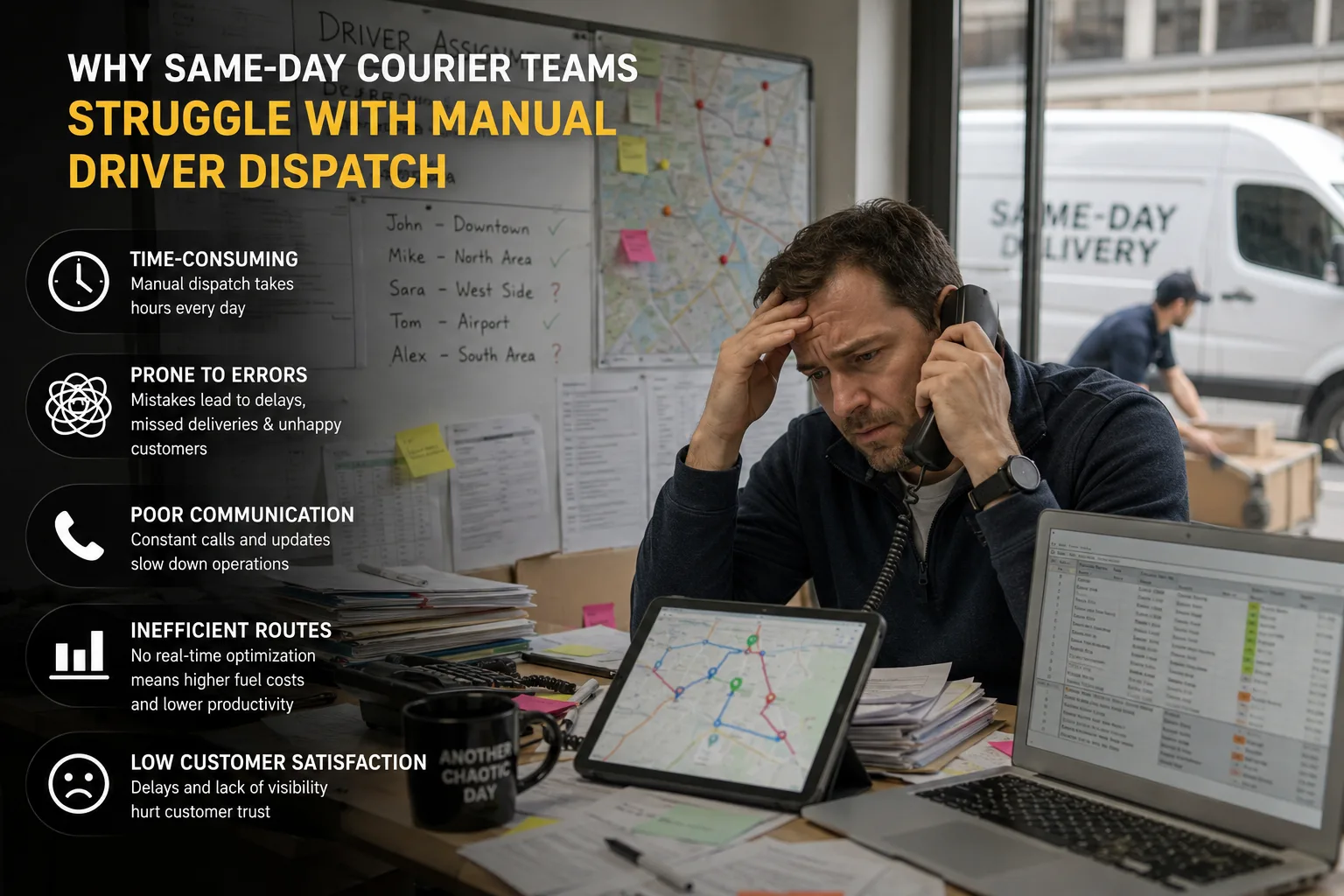

A good controller is not slow. They are overloaded. Allocating a same-day job well means holding half a dozen live variables at once, and human working memory runs out somewhere around four. Same-day courier dispatch software does not replace judgement; it removes the variables that were never worth spending judgement on.
The instinctive fix is to hire another controller, and the labour market makes that look easier than it was. Office for National Statistics figures show 2.6 unemployed people per vacancy in October to December 2025, up from 1.9 a year earlier. But a second controller doubles the number of people who need to know where every driver is, which is usually how a coordination problem becomes a communication problem.
This guide is for UK same-day and on-demand operators deciding how far to automate manual driver dispatch, and what they lose if they go too far.
What is same-day courier dispatch software?
Same-day courier dispatch software receives jobs, matches them to available drivers using configurable allocation rules, pushes the job to a driver app and tracks it through to proof of delivery. It is the layer between an order arriving and a driver moving.
Three functions distinguish it from general same-day delivery management software: it holds live driver positions and availability, it applies allocation logic rather than storing a decision someone else made, and it works in minutes rather than in overnight planning cycles.
| Function | What it replaces | Why it matters on same-day work |
|---|---|---|
| Job intake | Phone calls, emails, a booking inbox | Removes re-keying and timestamps the clock properly |
| Courier driver allocation software | The controller’s mental map and a whiteboard | Consistent decisions when volume spikes |
| Driver communication | Calls and WhatsApp messages | One record of what was offered, accepted and when |
| Real-time driver tracking software | Ringing the driver to ask where they are | Accurate ETAs and better next allocations |
| Proof of delivery | Paper sheets and photos on a personal phone | Evidence attached to the job, not to a handset |
Why manual driver dispatch breaks down
Manual driver dispatch fails not through carelessness but through arithmetic. To allocate one same-day job properly, a controller must simultaneously weigh:
- Where every available driver is right now, not where they were twenty minutes ago
- What each driver is already carrying and when they will clear it
- Vehicle type against the consignment: bike, car, small van, Luton with a tail lift
- The collection and delivery promise times, and the traffic between them
- Driver hours already worked, and whether the job fits inside them
- Which drivers will actually accept the job, and which will quietly decline it
That is six live variables per job, and they all change while the controller is on the phone about a different one. Most UK operators find the wheels come off somewhere between 30 and 40 same-day jobs per controller per day. Below that, local knowledge genuinely beats software. Above it, allocation quality falls in ways that are invisible until a customer complains: the second-nearest driver gets the job, the round doubles back, a promise time slips.
The tell is not chaos. It is that nobody can reconstruct why a particular driver got a particular job, which means nobody can improve the decision next time.
The five levels of dispatch automation
Automated courier dispatch is not a switch. It is a ladder, and the most common mistake is jumping to the top rung because that is what the demo showed.
| Level | How work is allocated | Suits | What to watch |
|---|---|---|---|
| 0 — Manual | Controller calls or messages drivers directly | Under about 30 jobs a day, one depot | The controller is a single point of failure |
| 1 — Assisted | System suggests a driver, controller confirms | Building trust in the data | Suggestions are only as good as live positions |
| 2 — Rules-based | Rules shortlist eligible drivers automatically | Most UK same-day operators | Rules drift out of date as the fleet changes |
| 3 — Auto-assign | System assigns directly; controller handles exceptions | High volume, homogeneous work, employed drivers | Removes driver choice, with goodwill and status implications |
| 4 — Offer and accept | Job offered to eligible drivers, who accept or decline | Self-employed driver pools | Needs a fallback when nobody accepts |
Level 2 is where most same-day operators should aim first. It captures the majority of the benefit, keeps the controller in the loop for anything unusual, and does not disturb how drivers are engaged. Levels 3 and 4 are not upgrades on each other; they are different answers to a different question, which is how your drivers are contracted.
How driver allocation rules actually work
Allocation rules are the configurable conditions that decide which drivers are eligible for a job and in what order they are considered. Understanding them matters because the defaults rarely match a UK same-day operation.
| Rule type | What it does | Where it misfires |
|---|---|---|
| Nearest available driver | Ranks by distance from collection point | Straight-line distance across a river or rail line |
| Radius from collection | Only considers drivers within a set distance | Too tight at night, too loose in rush hour |
| Vehicle type matching | Filters by bike, car, van or tail lift | Fails without accurate vehicle profiles |
| Workload balancing | Spreads jobs across the pool | Can send work past a closer idle driver |
| Driver selection | Drivers choose from offered jobs | Cherry-picking of the easy, well-paid runs |
| Priority and SLA | Weights urgent jobs above standard | Standard work starves during peaks |
In practice the useful configuration is layered rather than singular: filter by vehicle type, then by radius, then rank by travel time rather than distance, then apply a workload weighting so the same three reliable drivers do not absorb everything. Cherry-picking is the failure mode operators underestimate. If drivers can see and select jobs freely, the awkward runs sit unaccepted, and the controller ends up manually placing precisely the jobs that were hardest to place before. Capping declines, or pairing awkward jobs with attractive ones, is more effective than removing choice entirely.
Why the allocation method carries legal weight
This is the part of courier driver allocation software that vendors seldom raise, and it deserves attention before you configure anything.
Most UK same-day operators use self-employed drivers. GOV.UK guidance on employment status is unambiguous that status is determined by the reality of the working relationship, not by what an engager chooses to call it, and that describing someone as self-employed in a contract does not necessarily make them so. Control over how and when work is done is one of the factors that reality is judged on. A dispatch system that assigns work with no genuine ability to decline looks different, in practice, from one that offers work a driver can turn down. That is a live consideration when choosing between level 3 and level 4 above, and it is a question for an employment law adviser rather than a software vendor.
There is a safety dimension too. The Health and Safety Executive is clear that health and safety law applies to work on the road as it does on a fixed site, and that this extends to anyone engaged to work for you in the gig economy. Journey scheduling sits inside the risk areas employers are expected to manage. An allocation that only works if the driver speeds is not an efficient allocation; it is an uncontrolled risk with a timestamp on it. Dispatch software helps here precisely because it makes the promise visible before it is made, rather than after a controller has committed to it on the phone.
What real-time driver tracking is actually for
Real-time driver tracking software shows live vehicle or handset positions. Its most valuable use is not the customer-facing map, it is the allocation decision behind it.
A nearest-driver rule is only as good as the positions it reads. Tracking updating every few minutes produces genuinely nearest allocation; tracking updating on job events only produces confident-looking guesses. Beyond allocation, live positions give three things worth having:
- ETAs a customer service team can quote without ringing the driver
- Evidence of attendance when a customer disputes a failed collection
- Actual travel times that feed back into future allocation and pricing
One caution: tracking drivers, particularly self-employed ones, involves personal data and needs a clear, proportionate purpose communicated to them. Continuous location capture outside working hours is where operators create problems for themselves.
What to measure before and after
Do not switch anything on before you have a baseline. Without one you will be unable to tell whether automated dispatch improved the operation or simply changed it.
| Metric | How to measure it | Indicative manual figure | What good looks like |
|---|---|---|---|
| Time to allocate | Job received to driver confirmed | 3–6 minutes | Under 60 seconds |
| Jobs per controller per day | Jobs allocated divided by controllers | 30–40 | 100 or more |
| Reallocation rate | Jobs reassigned after first allocation | 10–20% | Under 5% |
| Driver acceptance rate | Offers accepted divided by offers sent | Not measurable manually | 85% or higher |
| Late collections | Collections after the promised window | Often unmeasured | Tracked and trending down |
The indicative figures are a starting point, not a benchmark, so take your own before you change anything. Time to allocate is the one to lead with, because it is easy to measure, immediately understood by everyone in the business, and it compounds: sixty jobs a day at four minutes each is four hours of controller time that could be spent on the twelve jobs that genuinely need a human.
Moving off manual dispatch without breaking the operation
The risk in a dispatch change is not technical. It is that drivers stop trusting the system in week one and never come back. A workable sequence:
- Weeks 1–2 — baseline and clean the data. Record time to allocate manually, and build accurate driver and vehicle profiles. Wrong vehicle data poisons every rule you write later.
- Weeks 3–4 — run at level 1. The system suggests, the controller decides. Log every time the controller overrides the suggestion and why. This is your rule-tuning dataset.
- Weeks 5–6 — tune the rules from the overrides. If controllers overrode the nearest-driver rule forty times because of the river, your radius logic needs travel time, not distance.
- Weeks 7–8 — move standard work to level 2. Keep urgent, oversized and named-account jobs with the controller. Automate the predictable majority first.
- Week 9 onward — review the exceptions monthly. Every job that needed manual intervention is either a rule to write or a genuine exception worth keeping human.
Tell drivers what is changing and why before it changes. A driver who understands that the system ranks by travel time rather than favouritism will tolerate an odd-looking allocation; one who thinks the office is playing favourites will not.
Summary
- Same-day courier dispatch software removes the variables that never needed judgement, not the judgement itself.
- Manual driver dispatch typically holds up to about 30–40 jobs per controller per day.
- Automation is a five-level ladder; level 2, rules-based allocation, suits most UK same-day operators.
- Layer allocation rules rather than picking one, and rank by travel time rather than straight-line distance.
- Whether you assign or offer work touches employment status and driver goodwill, so decide it deliberately.
- Baseline time to allocate before you change anything, or you will not know what improved.
See it run against your busiest hour
Dispatch software is easy to demonstrate on a quiet Tuesday. The test that matters is a Friday afternoon with three drivers unaccounted for and a job that needs a tail lift.
InstaDispatch provides same-day delivery software for UK courier and on-demand operators, with configurable driver allocation rules covering nearest driver, radius from collection and vehicle type matching, plus driver self-selection where that suits your engagement model. Job intake, allocation, driver app, live tracking, notifications, ePOD and invoicing run from one delivery management software platform.
Run dispatch, tracking, proof of delivery and invoicing in one place — see how InstaDispatch fits your delivery operation.
No credit card · Cancel anytime
