
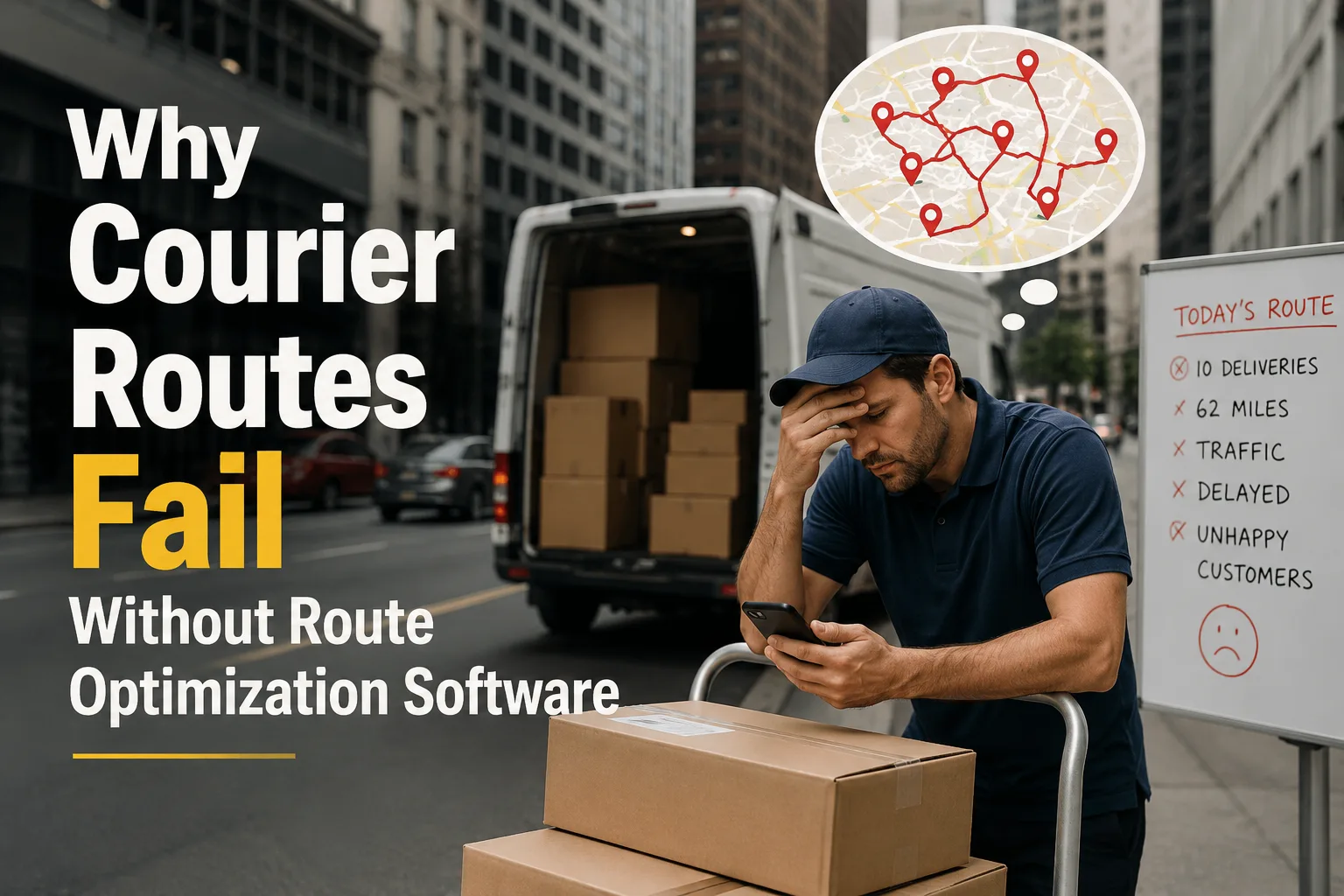

Courier route failure is rarely caused by one driver, one missed address, or one delayed parcel. In most delivery operations, routes fail because the planning process is disconnected from real operational conditions.
A route may look workable at the start of the day, but once drivers leave the depot, the problems begin. A customer changes availability. A same-day job is added. A driver gets delayed at the first stop. A delivery window is missed. Dispatchers start calling drivers for updates. Customers begin asking where their parcel is. By the end of the day, some jobs are completed late, some are rolled over, and the team has no clear view of what went wrong.
This usually happens when courier companies rely on spreadsheets, printed route sheets, manual dispatching, driver judgment, phone calls, or basic map tools. These methods may work for a small number of deliveries, but they become unreliable when businesses manage multiple drivers, routes, depots, pickups, collections, returns, and time-sensitive deliveries.
Route optimization software helps courier companies plan smarter routes, calculate more accurate ETAs, reduce unnecessary mileage, assign jobs more clearly, and track delivery progress from one platform. For courier and delivery businesses, route optimization is not only about finding the shortest route. It is about building delivery routes that work in real operations.
What Does a Failed Courier Route Look Like?
A failed courier route does not always mean every delivery on the route has failed. In many cases, the route still gets completed, but only after extra driver time, more support calls, increased mileage, missed delivery windows, and unnecessary pressure on dispatch teams.
Common signs of failed courier routes include:
- Drivers travel more miles than needed
- Deliveries are not sequenced properly
- ETAs keep changing throughout the day
- Drivers arrive too early or too late
- Customers miss deliveries because they were not informed in time
- Dispatchers keep calling drivers for delivery updates
- Urgent jobs are added without visibility of route impact
- Some drivers are overloaded while others still have capacity
- Failed delivery attempts increase
- End-of-day deliveries roll over to the next working day
For courier companies, these issues create more than operational inconvenience. They affect delivery cost, driver productivity, customer experience, and the ability to scale.
A route can fail even when every driver is working hard. The real issue is often the planning system behind the route.
Why Courier Routes Fail Without Route Optimization Software
1. Manual Route Planning Cannot Handle Real Delivery Complexity
Manual route planning may work when a business has a few deliveries in one area. But courier operations become more complex as delivery volume grows.
A courier company may need to manage:
- Multiple drivers
- Multiple delivery zones
- Time-sensitive deliveries
- Pickups and collections
- Returns
- Same-day jobs
- Customer availability
- Depot start and end points
- Vehicle capacity
- Driver availability
- Failed delivery reattempts
Spreadsheets and basic map tools are not built for this level of operational dispatching. They can store addresses, but they do not manage the full delivery workflow.
When dispatchers manually group jobs, estimate travel time, and assign routes, small errors can affect the full delivery day. One wrong sequence can delay several stops. One overloaded driver can miss multiple delivery windows. One urgent job added manually can disrupt the entire route.
This is where route optimization software becomes necessary. It helps courier companies move from static planning to structured, operational route planning.
2. Stops Are Not Sequenced in the Most Efficient Order
The order of delivery stops directly affects driver time, mileage, fuel usage, ETA accuracy, and customer experience.
Without courier route optimization, drivers may follow routes based on:
- Address list order
- Driver habit
- Manual assumptions
- Customer request order
- Printed sheets
- Basic map directions
This may seem manageable, but it can create inefficient route movement. A driver may pass near one customer early in the route, deliver somewhere farther away, and then return to the same area later. That adds unnecessary distance and time.
For multi-stop route planning, the sequence matters. A better stop order can help drivers complete more deliveries with less wasted travel. It also helps dispatchers create more realistic ETAs and reduce end-of-day delays.
Delivery route optimization software supports more structured sequencing so routes are not planned only by guesswork or habit.
3. Dispatchers Cannot Accurately Predict ETAs
ETA accuracy is one of the biggest challenges in courier operations.
Customers expect delivery updates. Dispatchers need to know whether a route is on schedule. Drivers need realistic route instructions. Customer service teams need reliable information when customers ask for delivery status.
When ETAs are based on manual estimates, they often become unreliable. This can lead to:
- Missed delivery windows
- Customer complaints
- More inbound support calls
- Failed delivery attempts
- Poor delivery visibility
- Pressure on drivers and dispatchers
A proper route optimization system can calculate ETAs based on the route start point, end point, route start time, stop sequence, planned delivery times, total distance, and route duration.
This is why ETA accuracy should not be treated as a customer communication feature only. It is an operational planning requirement.
4. Route Start Time and Delivery Time Are Not Connected
Many courier routes fail because the planning process does not connect route start time, arrival time, total route duration, and route end time.
For example, a dispatcher may know that a driver starts at 9:00 AM and has 30 deliveries. But without proper route planning, it is difficult to know:
- When the driver should reach the first drop
- Whether the route can be completed within working hours
- Whether delivery time windows are realistic
- What the route end time should be
- How a delay at one stop affects later deliveries
A strong route optimization system should support planning in both directions.
In one case, the dispatcher may enter the route start time, and the system calculates ETAs for each drop, total distance, total route time, and route end time.
In another case, the dispatcher may know when the driver needs to reach the first drop. The system should then help calculate the required route start time, ETAs for each stop, total distance, route duration, and route end time.
Without this connection, courier companies may send drivers out with routes that look acceptable but cannot realistically be completed on time.
5. Dispatch Teams Do Not Have Full Route Visibility
A courier route does not end when jobs are assigned. Dispatchers still need to monitor progress throughout the day.
If dispatchers cannot see route status, driver progress, completed jobs, delayed stops, failed attempts, and delivery exceptions in one system, they lose control of the delivery day.
This usually results in repeated phone calls:
“Where are you now?”
“Has this delivery been completed?”
“Why is this job still pending?”
“Can you take one more collection?”
“Has the customer received the parcel?”
Phone calls may solve one issue at a time, but they do not create route visibility.
Delivery tracking software and delivery dispatch software help teams monitor route progress more clearly. Instead of relying on driver updates by phone, dispatchers can see what is happening and respond faster when routes fall behind.
6. Last-Minute Jobs Break the Entire Plan
Courier operations are rarely fixed from morning to evening. Same-day jobs, urgent collections, failed delivery reattempts, customer changes, and returns can appear after routes have already been planned.
Without route optimization software, dispatchers may add these jobs manually without knowing the impact on:
- Route distance
- Driver workload
- ETA accuracy
- Existing delivery commitments
- Delivery time windows
- Route end time
A last-minute job may look simple, but it can delay several planned deliveries if it is added to the wrong route.
Route optimization for courier companies helps dispatchers understand how route changes affect the full delivery plan. This makes it easier to assign urgent work without breaking the rest of the route.
7. Drivers Waste Time on Unclear Instructions
Even a well-planned route can fail if drivers do not receive clear job instructions.
Common driver issues include:
- Missing address details
- Unclear delivery notes
- Incorrect contact information
- Poor stop sequence
- Manual updates from dispatch
- Confusion between pickups and deliveries
- No clear route visibility
When instructions are unclear, drivers spend time calling dispatch, searching for details, or making decisions on the road. This delays the route and increases pressure on the operations team.
Driver route planning works better when drivers receive structured routes, job details, delivery notes, stop order, and status update options through a connected driver mobile app.
This is where delivery management software becomes valuable. Route optimization should not sit separately from dispatching, driver communication, proof of delivery, and tracking.
8. Failed Deliveries Are Not Planned For or Recorded Properly
Failed deliveries are part of courier operations. Customers may not be available. Addresses may be incorrect. Access may be restricted. The delivery location may be closed. The driver may need additional instructions.
The problem is not only that a delivery failed. The bigger problem is what happens next.
If the failed attempt is not recorded properly, dispatchers may not know:
- Why the delivery failed
- Whether the customer was contacted
- Whether proof was captured
- Whether the job needs to be rescheduled
- Whether the route needs to be updated
- Whether the customer needs a notification
Without proper failed attempt records, courier companies repeat the same problems. The same parcel may be attempted again without better information.
A connected system should help teams capture failed attempt reasons, driver status updates, proof of delivery, delivery history, and rescheduling information.
This is why reducing failed deliveries depends on more than driver effort. It depends on clear delivery workflows.
9. Route Planning Is Not Connected to Customer Communication
Customers do not only want the parcel. They also want to know when it will arrive.
If route planning is not connected to customer communication, customers may receive outdated information or no updates at all. This can increase missed deliveries and support calls.
For example, if an ETA changes but the customer is not informed, they may leave the delivery location. If a failed attempt is not recorded and communicated, the customer may not know what happened. If dispatchers do not have live route visibility, support teams cannot provide accurate answers.
Connected delivery management software helps courier companies link route planning, ETA updates, delivery status, proof of delivery, and customer notifications.
For same-day delivery software, this connection is especially important because delivery expectations are tighter and routes often change during the day.
10. Operations Teams Cannot Learn From Route Performance
If courier companies do not measure route performance, the same problems repeat.
Operations teams need visibility into:
- Route distance
- Route duration
- Driver performance
- Completed deliveries
- Failed deliveries
- Delays
- Route efficiency
- Delivery completion rates
- Job history
- Customer communication issues
Without reporting, dispatchers may know that a day was difficult, but they may not know why. Was the route overloaded? Was the sequence inefficient? Were ETAs unrealistic? Were failed attempts concentrated in one area? Was one driver given too much work?
Route optimization software helps courier companies review delivery performance and improve future planning. This turns route planning from a daily guessing exercise into an operational process.
How Route Optimization Software Helps Courier Companies
Route optimization software helps courier companies plan and manage delivery routes more efficiently.
In practical terms, it can help businesses:
- Plan efficient multi-stop routes
- Improve stop sequencing
- Calculate more accurate ETAs
- Reduce unnecessary mileage
- Support start point and end point planning
- Connect route start time with planned delivery times
- Help dispatchers assign routes clearly
- Give drivers structured route instructions
- Improve delivery tracking visibility
- Manage failed delivery attempts
- Reduce manual phone calls
- Support better customer updates
- Review delivery performance after the route is completed
For courier companies, the main benefit is control. Dispatchers can plan routes more clearly, drivers can follow structured instructions, and customers can receive better delivery information.
Route optimization becomes more valuable when it is connected with courier management software, dispatch workflows, driver apps, proof of delivery, delivery tracking, and reporting.
Route Optimization Is Not Just About Shortest Distance
Many businesses think route optimization only means finding the shortest route. That is only one part of it.
In courier operations, the shortest route is not always the best route. A route may be short but still fail because it does not consider time windows, customer availability, driver workload, delivery priority, or route end time.
Effective route optimization should consider:
- Route start time
- Required arrival time
- Driver availability
- Delivery time windows
- Pickup and delivery sequence
- Total route time
- Total distance
- Route end time
- Customer expectations
- Failed attempt handling
- Dispatcher visibility
For delivery companies, route optimization software should support the way real routes work. It should help dispatchers plan routes that are practical, visible, and manageable throughout the delivery day.
Why Courier Companies Outgrow Manual Route Planning
Manual route planning often feels manageable in the early stages of a courier business. A dispatcher may know the drivers, customers, delivery areas, and common routes.
But as the business grows, manual planning becomes a bottleneck.
More delivery volume means more addresses, more time windows, more vehicles, more drivers, more customer expectations, more same-day jobs, and more exceptions. The dispatcher may still be experienced, but the planning process becomes harder to control manually.
At this stage, spreadsheets and phone calls create operational risk. A single dispatcher may hold too much route knowledge. Drivers may depend on manual instructions. Customer updates may become inconsistent. Reporting may be limited.
This is why growing courier companies often need delivery dispatch software, route planning software, and delivery management software that can support higher delivery complexity.
Manual planning does not usually fail because teams are careless. It fails because the operation has outgrown the tools.
Where InstaDispatch Fits In
InstaDispatch helps courier and delivery businesses manage delivery operations through connected delivery management tools.
For route planning, InstaDispatch supports courier companies with route optimization, delivery dispatching, ETA planning, driver visibility, proof of delivery, delivery tracking, customer updates, and delivery management workflows.
For delivery companies, route optimization is most useful when it is not isolated from the rest of the operation. A planned route should connect with dispatch, driver apps, delivery status updates, failed attempt records, customer communication, and reporting.
That connection helps courier companies move from manual route planning to more structured delivery operations.
Conclusion
Courier routes fail when planning is disconnected from real delivery conditions. Manual planning may look manageable at the start of the day, but it cannot reliably handle multi-stop routes, changing delivery priorities, ETA expectations, customer updates, failed attempts, and dispatcher visibility.
As delivery volume grows, courier companies need more than spreadsheets, basic maps, phone calls, and driver judgment. They need best route optimization software that helps plan smarter routes, calculate accurate ETAs, improve driver productivity, manage failed attempts, and give dispatchers better control of the delivery day.
Plan smarter courier routes with InstaDispatch route optimization software. Book a demo to see how InstaDispatch can help your delivery business improve route planning, ETA accuracy, and delivery visibility.
